
Government Grants and Tax Incentives for Service Robot Deployment
At a glance: A robot that lists at a given price rarely costs that much to own. Between accelerated depreciation, capital allowances, and the productivity or energy-efficiency grant programmes many jurisdictions run, the effective capital outlay on a service robot can fall well below the invoice figure. But every one of those schemes is claimed, not granted, and the claim lives or dies on documentation. This guide sets out the incentive categories a facilities buyer should check before signing, the accounting treatment that shortens payback, and the evidence pack that keeps a claim intact under audit.

Why the Payback Calculation Should Start Below the Invoice Price
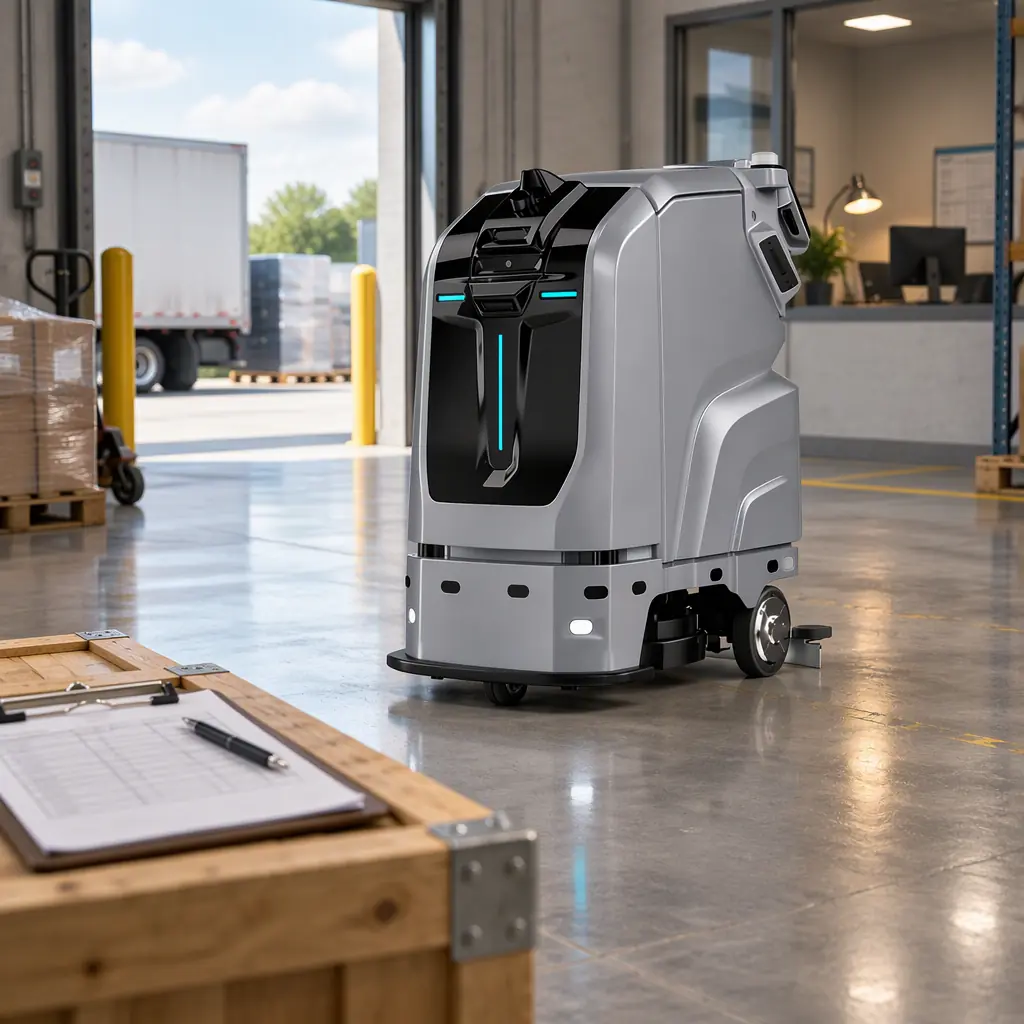
Most service robot business cases are built on the purchase order figure, and that is the first error. The number that matters to a finance director is the net capital cost after every lawful incentive is applied, and on a fleet-scale purchase the gap between gross and net routinely reaches into double-digit percentages. A single AOMAN C1 assigned to a large-format retail floor, or a fleet of AOMAN D1 delivery units across a hospital campus, can be partly funded by schemes the operator has never been told about, because the vendor's job ends at the invoice and the claim is the buyer's to make.
The three levers stack, and they are not mutually exclusive in most tax systems. The first is accelerated depreciation or a first-year capital allowance, which does not reduce the price but pulls the tax deduction forward, improving the after-tax cash position in the year of purchase. The second is a direct grant or subsidy for productivity, automation, or energy efficiency, which reduces the cash paid. The third is an energy or sustainability incentive, which applies when the robot replaces a diesel or high-energy process. The distinction between the levers matters because they are claimed from different bodies, on different forms, against different evidence.
Before any of this, the baseline number itself must be trustworthy. A payback model fed by a guessed productivity baseline is a payback model that will not survive finance review; the measurement method is set out in the productivity baseline guide, and it should be completed before the incentive stack is even modelled, because the grant bodies will assume the savings are real.
The Four Incentive Categories to Check Before You Sign
Incentive programmes differ by country and region, but they cluster into four recurring categories. Run each of the four against the purchase before the contract is signed, because two of them depend on facts you can only document at the point of procurement.
| Category | What it rewards | Typical evidence required | Timing constraint |
|---|---|---|---|
| Accelerated depreciation / capital allowance | Capital investment in plant and machinery | Invoice, asset register entry, in-service date | Claimed in the tax return for the year the asset is in service |
| Productivity or automation grant | Measurable labour savings or output gain | Before/after productivity data, project plan | Usually must be pre-approved before purchase |
| Energy-efficiency or decarbonisation grant | Reduction in energy use or emissions | Metered baseline, post-install metering | Baseline must be measured before installation |
| Small-business or regional development incentive | Investment by qualifying enterprises or in target regions | Enterprise size certification, site location record | Varies; often annual windows |
Two of these have a hard sequencing rule that buyers routinely break. A productivity grant usually requires pre-approval: purchasing the robot first and applying afterward disqualifies the claim. An energy grant requires a pre-installation metered baseline: if the old process is decommissioned before the meter reading is taken, the savings cannot be evidenced and the claim collapses. Both rules mean the incentive check belongs in the procurement process, not the accounts-payable process.
Accelerated Depreciation: The Lever Most Buyers Leave on the Table
Accelerated depreciation is the simplest lever and the most commonly missed. Under straight-line accounting, a service robot might be written down over five to eight years; under an accelerated regime, a large share of the cost may be deductible in the first year. The cash consequence is real: a faster deduction lowers taxable profit earlier, which improves the cash available to service the purchase in the very year the outlay lands.
Whether a robot qualifies often turns on its classification. In many tax systems the asset must be plant and machinery used in a business, not inventory held for resale, and the deduction depends on the asset being in service rather than merely delivered. That is why the commissioning record matters for finance as well as engineering: the acceptance and commissioning gate described in the acceptance testing guide produces the in-service date that the depreciation claim references. A robot that is delivered in December but commissioned in February belongs to the February tax year.
- Keep the asset register current. Each unit needs a serial, an in-service date, a location, and a cost. A pooled fleet entry is harder to defend than a per-unit register.
- Separate capital from consumable. The robot is capital; the brushes, filters, and detergent are not. Mixing them weakens both the depreciation claim and the operating cost model.
- Record the disposal. When a unit is retired, the residual and disposal treatment must be documented, which is the subject of the decommissioning guide.
Grants Are Won on Evidence, Not on Enthusiasm
A grant application is a claim that a specific, measurable improvement will result from a specific purchase. The grant body is not funding the robot; it is funding the outcome, and it will ask the applicant to prove the outcome happened. This is where the operational metrics that a good deployment already collects become financially valuable.
Productivity grants typically require a before-and-after comparison. The before number is the manual productivity baseline; the after number is the robot's measured output. If the operator has been tracking output in square metres per labour hour, as described in the labour cost model, the grant evidence already exists in the operational data. If it has not, the grant application becomes a retrospective measurement exercise that is both costlier and less credible.
Energy grants follow the same logic. A cleaning robot that replaces a ride-on scrubber running on diesel, or a delivery fleet that replaces vehicle trips inside a large campus, produces an emissions delta that a decarbonisation grant will fund — but only if the pre-installation energy use was metered. The energy economics that underpin that case are developed in the fleet energy and demand-charge guide, and the same kWh figures feed both the grant claim and the operating budget.
Building the Evidence Pack That Survives an Audit

Incentive claims are audited, sometimes years later, and a claim that cannot be evidenced is clawed back with interest. The evidence pack is not a single document; it is a set of records assembled across procurement, operations, and finance. Assemble it from day one, because reconstruction after the fact almost always fails.
- The pre-purchase record. The dated productivity or energy baseline, the project justification, and — for a pre-approved productivity grant — the approval letter dated before the purchase order.
- The procurement record. The invoice, the asset classification note, and the serial-level asset register with in-service dates.
- The operational record. Metered or system-logged output after commissioning, on the same measurement basis as the baseline. A robot fleet management platform that logs coverage and run-hours is the cleanest source of this data; the software-side discipline is covered in the fleet software guide.
- The finance record. The depreciation schedule, the grant income account, and the reconciliation between gross cost, incentive income, and net capital cost.
Two errors are common enough to name. First, claiming an incentive against a purchase that does not meet the eligibility test — the asset that was leased rather than bought, or the unit that was deployed outside the qualifying region. Second, double-counting the same cost across two schemes that prohibit stacking. Read the stacking rules before assuming the levers are additive. The vendor will not know your jurisdiction's rules, and the grant body will not correct your form.
What This Means for the Total Cost of Ownership
The incentive stack does not change the robot's operating economics; it changes the capital entry point. A lower net capital cost shortens payback, and payback is the figure most often used to approve or reject a fleet purchase. The full ledger that the incentive income feeds into — energy, consumables, maintenance, and downtime — is set out in the total cost of ownership guide, and the incentive income is one line in that ledger, not the whole calculation.
The practical sequence is short. Before the purchase order: confirm which incentives apply, check any pre-approval and pre-measurement deadlines, and take the metered or measured baseline. At purchase: record the asset at serial level and classify it correctly. At commissioning: capture the in-service date that finance needs. After deployment: keep logging output on the same basis so the claimed savings are evidenced rather than asserted. Done in that order, the incentives reduce a real cost with real evidence, and the payback figure a finance director approves is the one the operator actually gets.
If you are scoping a fleet and want the capital-cost model built against your jurisdiction's incentive rules, request a quote through the enquiry form and we will work the numbers with your finance team.

Get a Quote
Tell us about your space and workload, we reply within 24 hours.