Cleaning Robot Total Cost of Ownership, The Full Five-Year Ledger
At a glance: Most cleaning robot quotes show one number. The real five-year cost is five ledgers: capital, consumables, power, service and downtime. This model prices a 1,500 m² daily route with 2026 unit economics and shows which lines a vendor quote usually omits.
Why the Quoted Price Is Roughly 60% of the Cost
When a facility manager asks a cleaning robot supplier for "the price", the answer is almost always the acquisition cost of the machine. That figure is real, but on a five-year horizon it lands between 55% and 65% of the total. The remaining 35% to 45% arrives as consumables, electricity, scheduled service, unplanned downtime and the residual value at the end, and every one of those lines is predictable before you sign.
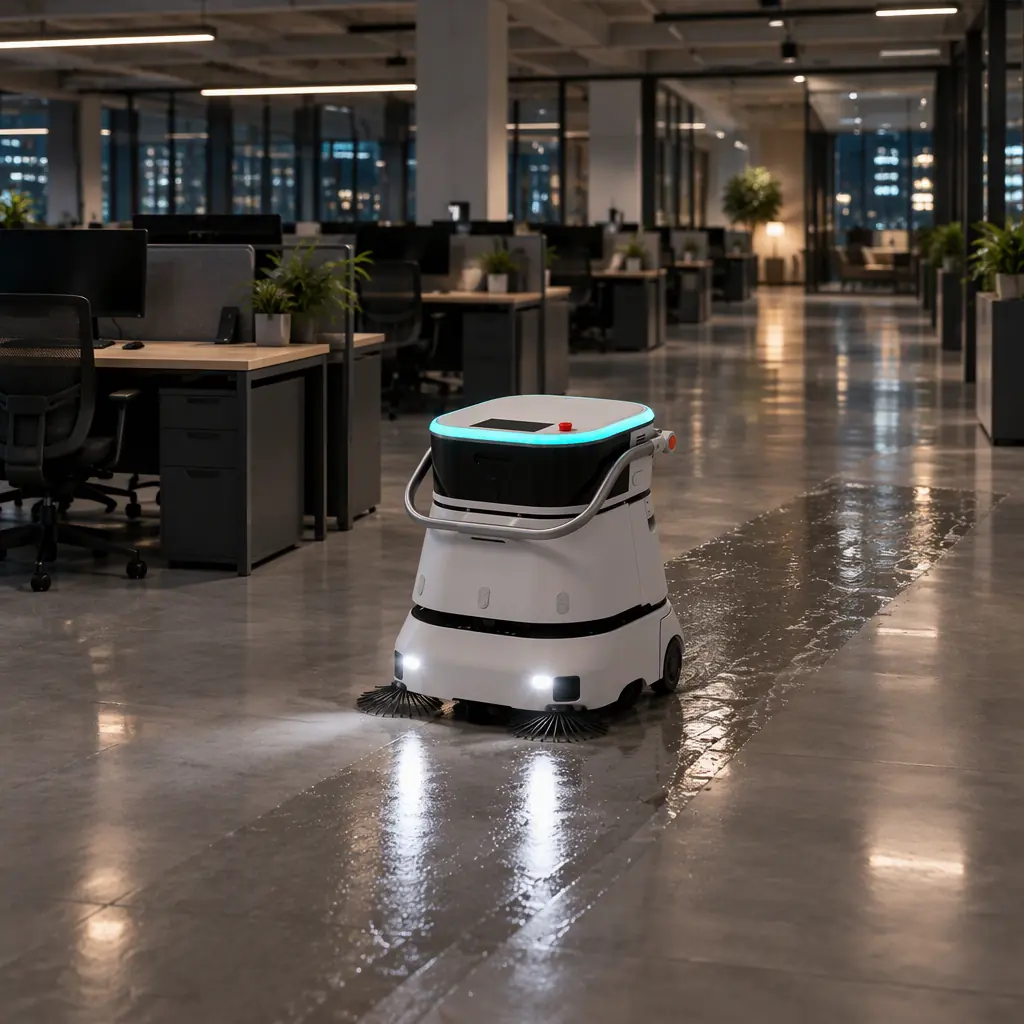
The arithmetic below prices a specific, realistic case rather than a range of hypotheticals: a single mid-size compact scrubber running a 1,500 m² nightly route, 300 operating nights per year, in a mixed office and lobby environment. Change the inputs to match your building and the shape of the curve holds even where the numbers move.
The Five Ledgers, Itemised
Ledger 1, Capital and Installation ($18,000-$34,000)
Purchase price for a commercial-grade compact scrubber in 2026 sits between $16,000 and $30,000 for the machine, with $2,000 to $4,000 added for dock installation, electrical work at the charging location and site commissioning. The capital line is the most visible and the least negotiable, which is exactly why it receives the most attention and deserves the least.
If you are financing rather than buying, the capital line converts to a lease or RaaS payment and shifts down while the service line shifts up. The five-year total is usually within 8% to 12% either way; what changes is when the cash leaves your account, not how much of it does. Our comparison of lease versus buy break-even works through that trade explicitly.
Ledger 2, Consumables ($4,500-$9,000 over five years)
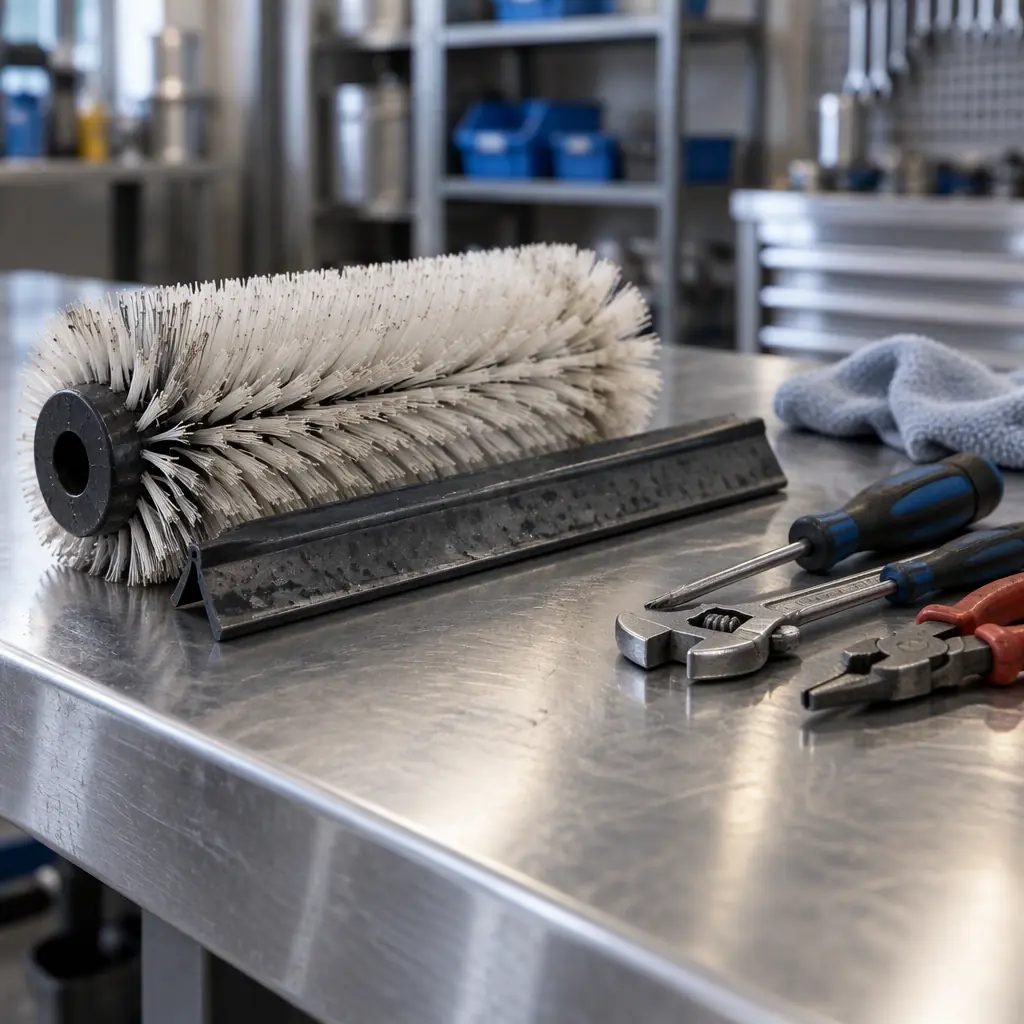
Brush wear, squeegee blades, filters and detergent are the consumables that scale with floor area. On the 1,500 m² nightly route above, budget one main brush replacement per 10 to 14 months, squeegee blades every 4 to 6 months, and filter sets every 6 months. Detergent consumption depends on the floor type and dilution ratio: a neutral cleaner at a 1:200 dilution runs roughly 0.4 to 0.7 litres of concentrate per 1,000 m², which for this route works out to about $280 to $450 per year at 2026 concentrate prices.
This ledger is where the least honest quotes live. Vendors frequently present consumable pricing as "standard maintenance included", then bill blades and filters separately after warranty. Ask for a written consumables price list with part numbers before signing.
Ledger 3, Power ($900-$1,600 over five years)
Power is small but not negligible, and it is the line most often estimated wrongly because people apply a commercial tariff to a nameplate rating. A compact scrubber drawing 900 W during operation and 350 W during charge, running 4.5 hours per night and charging 3 hours, consumes roughly 5.1 kWh per night, or about 1,530 kWh per year. At commercial rates of $0.13 to $0.20 per kWh, that is $200 to $310 per year.
The detail that changes the number is when the charging happens. If you charge on-peak, a demand charge can multiply the effective rate by two or three. Our electricity cost analysis covers the demand-charge trap and how to size the supply circuit; our charging infrastructure planning guide covers the electrical work itself.
Ledger 4, Service and Parts ($6,000-$14,000 over five years)
Scheduled service is the ledger that decides whether the five-year total looks acceptable or alarming. A defensible plan for one machine is two preventive visits per year at $350 to $600 per visit, plus an allowance for unscheduled parts. The parts allowance is where quotes diverge most: brush motors, drive wheels, wheel encoders and battery packs are the four components that consume most of the unplanned parts budget in commercial cleaning fleets.
Battery deserves its own line. A lithium pack in a nightly cleaning duty cycle typically reaches 70% of original capacity somewhere between year three and year five, and the capacity decline is what forces replacement, not outright failure. A replacement pack runs $1,800 to $3,500 installed. If the machine is being kept beyond year four, put the pack in the model at year four rather than treating it as a surprise.
Ledger 5, Downtime ($0-$9,000 over five years)
This is the only ledger that can rationally be zero, and it is the one most often left out. Downtime costs money only where the work the robot would have done has to be covered by someone else at short notice, or where the shortfall shows up in a service contract penalty. In a facility with staff who can absorb the route, the cost is productivity loss, not cash. In a facility running a fixed-scope cleaning contract, an unplanned robot outage can trigger overtime coverage.
Price it as expected downtime hours multiplied by your incremental coverage rate. A fleet with a mean time between failures of 500 operating hours will produce roughly 2.7 failures over 1,350 operating hours per year if repairs restore service within the window. The relevant measurement practice is covered in our downtime cost and OEE analysis.
The Five-Year Ledger, Assembled
Applying the midpoints of each ledger to the 1,500 m² nightly route gives the following picture. This is a cash total, not a discounted present value.
| Ledger | Five-year total | Share |
|---|---|---|
| Capital and installation | $24,000 | 46.5% |
| Consumables | $6,750 | 13.1% |
| Power | $1,250 | 2.4% |
| Service, parts and one battery pack | $11,500 | 22.3% |
| Expected downtime coverage | $4,000 | 7.8% |
| End-of-life residual value | -$4,000 | -7.8% |
| Net five-year cost | $43,500 | 100% |
The two rows that surprise facilities are the battery-inclusive service ledger at 22% and the residual credit. Most quotes present service as a small annual percentage of capital and omit the residual entirely, which makes the total look worse than it is while hiding where the real money goes.
Converting the Ledger to a Cost per Square Metre
Divide the net five-year cost by the area actually cleaned over the same period and the number becomes comparable across machines, sites and modes. This route cleans 1,500 m² per night, 300 nights per year, for five years: 2,250,000 m². That yields $0.0193 per square metre, or $19.30 per 1,000 m².
Put that alongside manual cleaning at a loaded labour rate of $22 per hour and 350 m² per hour for a single operative, and manual cleaning costs $62.86 per 1,000 m². The robot figure is roughly 31% of the manual figure, and the entire saving sits in the labour rate and coverage rate, not in the machine's purchase price. This is why the same robot in a low-wage market produces a much weaker case, and why the arithmetic must be run on your own rates. The labour side of this comparison is worked through in detail in our labour cost model.
| Method | Cost per 1,000 m² | Basis |
|---|---|---|
| Manual, single operative | $62.86 | $22/hr loaded, 350 m²/hr |
| Robot, five-year TCO | $19.30 | $43,500 net / 2.25M m² |
| Robot, excluding downtime | $17.52 | Sensitivity: zero downtime cost |
| Robot, with mid-life battery at year 3 | $20.19 | Sensitivity: earlier pack replacement |
The sensitivity rows matter more than the headline. Moving the battery replacement a year earlier or removing downtime from the model changes the cost per square metre by about 12%, which is smaller than the change produced by a 15% shift in your loaded labour rate. Labour rate, not robot specification, is the dominant variable in every one of these models.
What to Demand From the Quote
Take the five ledgers to the negotiation and require each one in writing:
- Consumables price list with part numbers, valid for 24 months, covering brushes, squeegees, filters and detergent concentrate.
- Service plan definition stating visit count, what a visit includes, and the labour rate for work outside the plan.
- Battery replacement trigger stated as a capacity threshold such as 70% of nameplate, with the installed replacement price fixed at contract signature.
- Downtime remedy defining response time and whether a loaner unit is provided during repairs beyond a stated duration.
- Residual or buy-back option at end of term, if offered, expressed as a percentage of original capital.
A supplier who will not put those five lines in writing is telling you the omitted 40% is where their margin lives. That is not automatically disqualifying, but it should be priced as risk. The contract clauses that govern these commitments are dissected in our warranty and service contract terms guide, and the KPI targets that let you audit them after year one are in our KPI benchmarks.
AOMAN FUTURE publishes consumable and service pricing for the C1 and C2 Pro cleaning platforms on request, including the battery capacity threshold that triggers replacement and the fixed installed price of a replacement pack at current terms. If you are building a five-year model for a specific route, send us the floor area and shift pattern and we will return the ledger filled in with your numbers rather than a range.