Service Robot Spare Parts & Consumables Planning, The Recurring Cost Nobody Budgets For
At a glance: Spare parts and consumables typically run 12–18% of a service robot's total lifetime cost, yet most fleet budgets treat them as a rounding error. This guide gives a planning framework: which parts wear, how fast, what to stock on site versus order per incident, and how to size a spares budget before the first machine arrives.
A fleet manager who has signed the purchase order usually has a clear model for the capital cost, a rough model for the service contract, and no model at all for the box of parts that keeps the machines running in year three. That gap is where unpleasant surprises live. The arithmetic is not complicated, but it has to be done before the fleet is installed, because the alternative, ordering a wear part from the other side of the world while a machine sits idle, is paid in downtime rather than in invoices.
What Actually Wears Out on a Service Robot
Across a cleaning and delivery fleet, the wear list is short and predictable. It divides into three groups by lifespan and consequence.
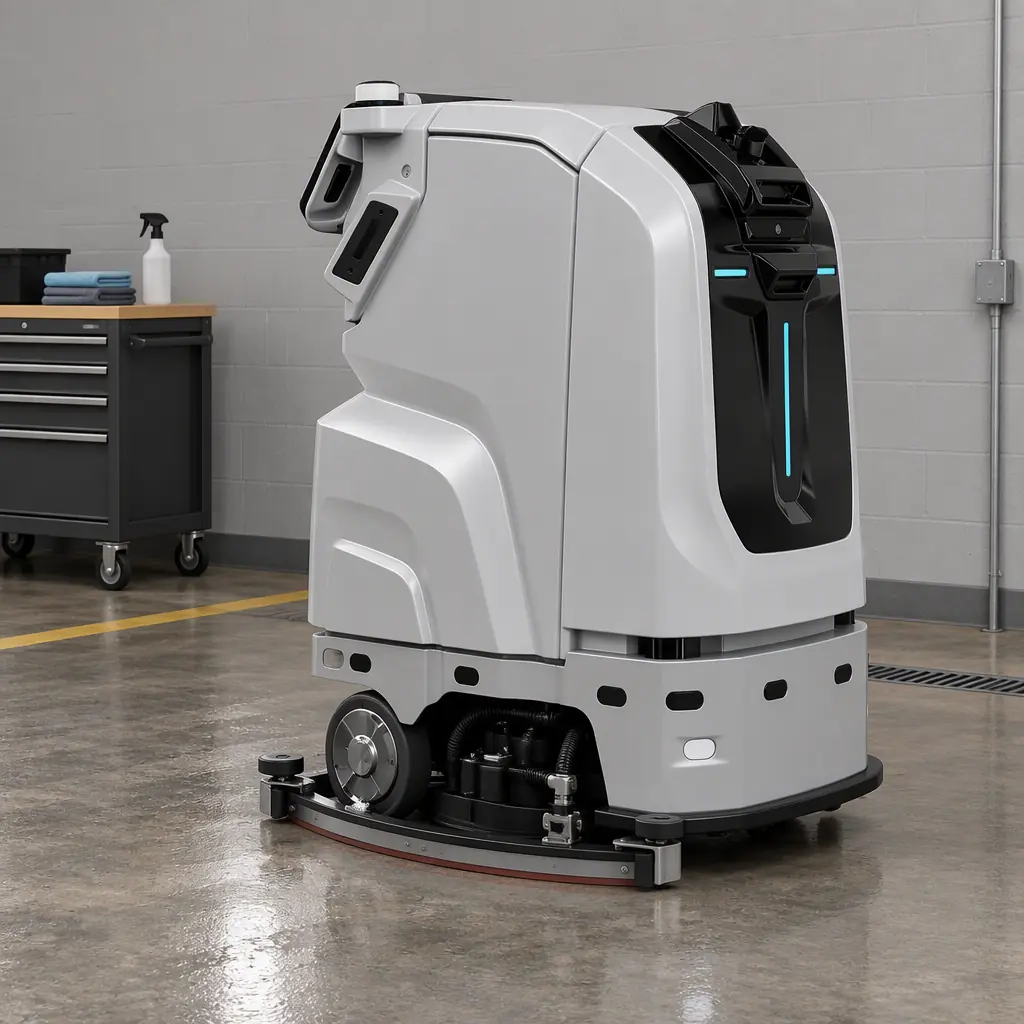
Consumables (weeks to months). These are the parts designed to be replaced on a schedule: scrubber brushes and brush skirts, squeegee blades, filter elements, pre-filter pads, mop pads, and water-tank seals. A cylindrical brush on a scrubber running two shifts a day reaches end of life in roughly 800–1,200 operating hours; a squeegee blade in a facility with expansion-joint flooring may need replacement in three to five months because the joints cut the rubber.
Scheduled wear components (months to a year). Drive wheels and their tread, caster assemblies, drive belts, castor bearings, and bumper/skirt hardware. Wheel tread on a machine doing 8–10 km per shift is usually good for 12–18 months indoors on sealed concrete, and considerably less in a facility with grit tracked in from outside.
Condition-based components (a year plus). Motors, motor controllers, LiDAR units and their drive belts, battery packs, and the on-board compute. These are not stocking items for most operators. But they do have lead times, and that is the real planning problem.
The Lead-Time Maths That Decides What You Stock
Stocking decisions should be driven by one number: how long a machine is idle if that part fails with none on the shelf. Compare that against how long the part survives on the shelf versus how often it fails.
A workable rule for a fleet of ten or more machines: stock any part whose lead time exceeds the acceptable mean-time-to-repair (MTTR) the operation has committed to. If the site's service commitment is 24 hours and a brush assembly ships in five days, the brush is a stocking item no matter how cheap it is. Because the cost of the part is trivial next to the cost of the idle machine. Fleet downtime economics are covered in more depth in our guide to measuring idle machine hours.
The corollary matters just as much: do not stock what ships in a day. Holding a year of inventory on fast-moving common parts ties up cash and creates obsolescence risk when a platform is refreshed.
Building a Spares Budget from Real Numbers
For a mid-size scrubbing fleet, the following ranges are a reasonable starting assumption. They are per machine, per year, and they assume roughly 2,500–3,000 operating hours.
| Category | Typical annual cost | Notes |
|---|---|---|
| Brushes and skirts | $280–$520 | 2–3 sets/year at two shifts |
| Squeegee blades and seals | $120–$260 | Higher with jointed flooring |
| Filters and pads | $90–$200 | Dust-heavy sites run high end |
| Wheels, casters, belts | $180–$400 | Material-handling exposure drives variance |
| Battery amortisation | $400–$900 | Pack life 3–4 years, spread annually |
| Total consumables + wear | $1,070–$2,280 | Per machine, per year |
Against a machine with a five-year service life, that puts non-capital replacement cost in the 12–18% band of lifetime spend, meaningful, but not alarming, provided it is budgeted. The full lifetime picture, including service contracts and labour, is set out in our maintenance and TCO guide.
The Shelf-Life Problem Nobody Mentions
Parts that sit too long fail too. Rubber and elastomer components, squeegee blades, seals, tyres, belts, age even in a box: ozone, heat and UV harden them. A squeegee blade stored in a hot loading bay for two years may be unusable on the day it is needed.
Two practical consequences. First, rotate stock first-in-first-out the way a workshop rotates oil. Second, set stocking quantities to roughly one replacement cycle plus a small buffer, not to a year's worth. For a ten-machine fleet, that usually means two to four units of each fast-moving part on the shelf, not twenty.
What to Put in the Purchase Contract
Spare-parts terms belong in the original agreement, not in a later negotiation. Five clauses are worth insisting on. First, a published parts list with part numbers and unit prices at contract signature. Second, a guaranteed lead time for critical parts, with a remedy if it is missed. Third, a commitment that fast-moving parts will remain available for the platform's service life: typically five to seven years, or a documented last-time-buy notice. Fourth, the option to hold consignment stock on site, which converts a lead-time risk into a monthly invoice. Fifth, equivalency language: the right to use functionally equivalent third-party consumables without voiding the warranty on parts they do not touch.
That last clause is contested more than any other, and it is worth understanding what a supplier will and will not accept before the conversation starts. The evaluation criteria are set out in our RFP template and in the broader 12-point vendor framework.
Running the Spares Programme in Practice
Once the fleet is live, three habits keep the parts programme honest. Log every part consumed against the machine and the operating hours at the time. This converts manufacturer estimates into your site's actual wear rates, which are almost always worse in a real facility. Review the log quarterly and adjust stocking levels. And treat a part that fails twice inside its expected life as a symptom, not a consumable: repeated squeegee or wheel failures usually point at floor condition, dock ramps or drive parameters rather than at the part itself. Diagnosing that class of problem is the subject of our guide to common failure modes.
Teams that get this right stop treating spares as procurement noise and start treating them as an operating input with a schedule, a budget line and a supplier relationship behind it. Teams that do not tend to discover the problem in month fourteen, with a machine down and no brush on the shelf.