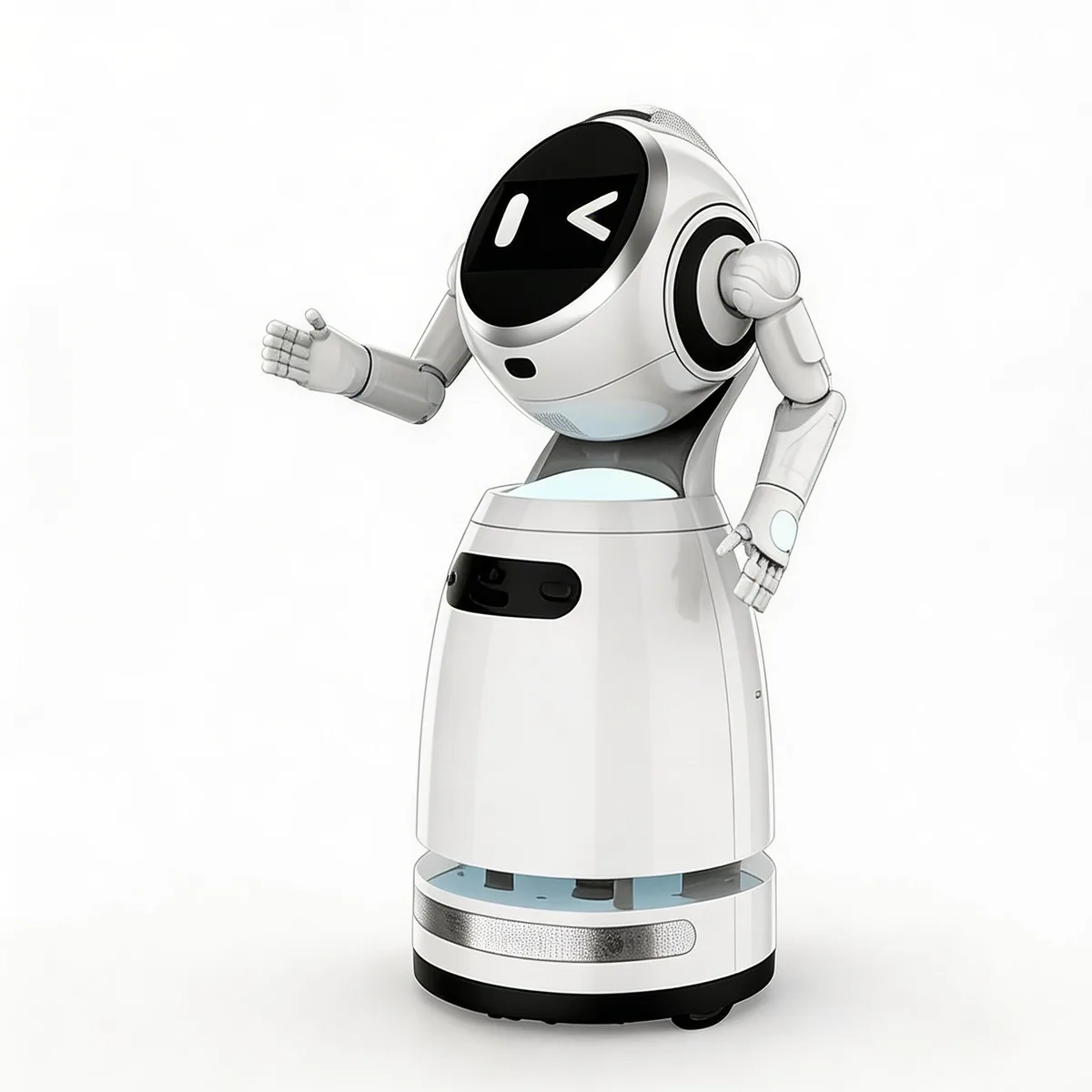
An independent pharmacy in Columbus, Ohio, fills about 380 prescriptions a day across a 5,200 sq ft store with a staff of 11: two pharmacists, five technicians, and four front-of-store employees who double as cashiers, shelf stockers and pickup-counter runners. The store's digital prescription volume has tripled since 2021 — patients order on the pharmacy app, and a technician walks a filled bag from the dispensing bench in the back to the pickup counter, a 90-meter round trip through the sales floor, an average of 140 times a day. The pharmacy owner's time study found those walks consumed 4.6 technician-hours per day, and that was before the cleaning crew quit for the third time in eighteen months.
The pharmacy is a uniquely dense retail environment: regulated dispensing, patient privacy obligations, perishable and cold-chain inventory, and a sales floor that stays open 12–14 hours a day. The medical clinics guide covered robots in the clinical setting; this guide covers the retail pharmacy — where the robot's job is not clinical care but the logistics, cleaning and front-of-store service that keep the pharmacy running on margin.
The Backroom-to-Counter Problem: Where Delivery Robots Pay First
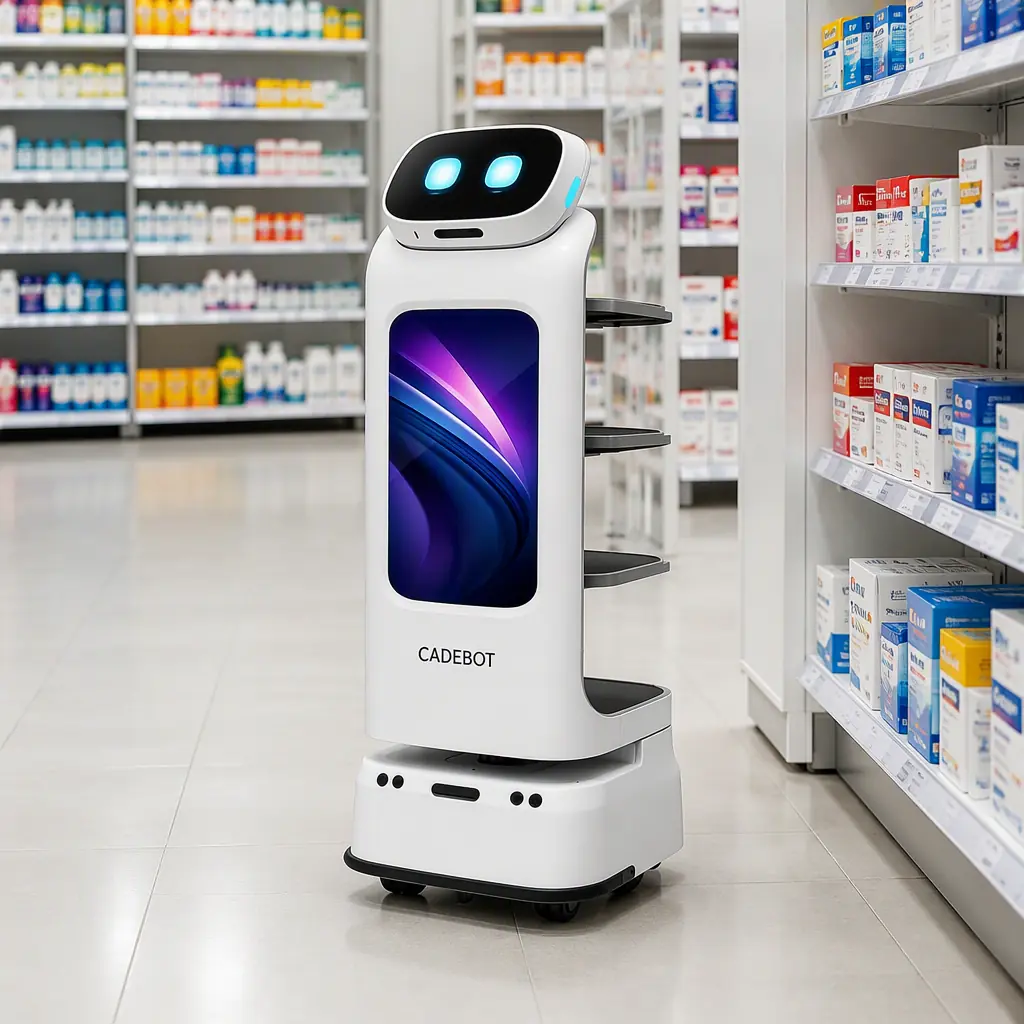
The highest-value robot deployment in a pharmacy is not on the sales floor — it is the 90-meter walk between the dispensing bench and the pickup counter. Every filled prescription travels that route, and in high-volume stores the route is walked by a technician whose hourly cost the pharmacy pays to be a courier. The delivery robot (the CADEBOT L100 in compact stores, the AOMAN DOUBLE 70L where the store moves cold-chain or bulk orders) takes over the walk: the technician loads a tote at the dispensing bench, the robot carries it through the sales floor to the pickup counter, and the robot returns with empty totes and return-to-stock items.
The economics follow the delivery robot selection guide: a 5,200 sq ft store like the Columbus example runs 4.6 technician-hours per day on those walks; at a loaded rate of $24–30/hour, that is $2,800–4,100 a month of technician time — against an all-in robot subscription of $1,200–1,800 per month under the RaaS financing model. The payback is immediate, and the secondary effect matters more to pharmacy owners: technicians stop leaving the dispensing bench, which means the pharmacist stops covering the bench, which means more prescriptions per pharmacist hour. The pharmaceutical GMP guide documents the same logic in sterile manufacturing: remove the walking, and the licensed headcount does licensed work.
Click-and-Collect and Curbside: The Workload That Broke the Front Counter
Chain and independent pharmacies alike report the same shift: digital prescriptions now represent 25–40% of volume, and the physical work — retrieving the bag, walking it to the counter or the curbside handoff point — is unchanged regardless of how the order was placed. Curbside pickup adds the worst-case version: a staff member must leave the store, walk to the car, confirm identity, hand over the bag, and return — 4–6 minutes per order in a queue that peaks at lunch and after 17:00.
The deployment pattern that works in production pharmacies mirrors the supermarket and grocery store guide: the robot takes the bag from the dispensing area to a staged pickup zone at the front of the store, and the pickup staff covers only the last 3 meters — the identity check and the handoff, which no robot should do for a controlled medication. The robot also runs the reverse logistics loop: signed returns, cold-chain items that missed pickup, and OTC baskets returned by customers. The key design rule is documented in the safety standards guide: the robot moves the package, never the medication decision — the pharmacist's verification step is untouched, which is also what keeps the deployment compliant with state pharmacy board rules.
Floor Care That Can't Interrupt Dispensing
Pharmacy floors are a cleaning problem with a schedule constraint: the sales floor and consultation area must be clean for patient-facing operations, the dispensing area must stay clean per pharmacy hygiene expectations, and neither can be shut down during operating hours. Commercial cleaning at pharmacies runs $0.10–0.18 per sq ft per month in most US markets — roughly $600–1,100 a month for a 5,000 sq ft store — and the turnover problem documented in the Columbus example is not unusual; retail cleaning staff churn is among the highest of any facility role.
The CLEINBOT M79 scrubber runs the sales floor after hours and between peaks: single-pass scrub, vacuum and mop at up to 2,000 m²/h covers a 5,000 sq ft store in about 12 minutes, the adjustable water output (0–300 mL/min) handles the transition from tile sales floor to the carpeted consultation corner, and the 45L water tank with auto-return docking means the machine self-services overnight. The quiet mode — approximately 58 dB(A), comparable to a conversation — lets it run during operating hours in low-traffic periods without disturbing patients at the consultation window. The commercial cleaning robot buyers guide covers the specification comparison; the operational point for pharmacies is the same one the fitness and wellness guide makes for high-traffic venues — the floor is a patient-facing surface, and the cleaning schedule is part of the patient experience.
Front-of-Store: CRUZR and the Privacy-Aware Service Layer
The front of the pharmacy generates a repetitive question load that never appears in the job description: where is the consultation window, how long until my prescription is ready, where is the restroom, where is the cough-and-cold aisle, how do I refill by phone. In a 12–14 hour day these questions number in the dozens, and every one pulls a staff member off a task that requires their actual license.
CRUZR, the humanoid service robot, absorbs the repetitive layer — the same deployment pattern the reception and concierge guide documents for corporate lobbies and the medical clinic guide covers for outpatient settings. It greets customers at the entrance, answers the standard questions from its configurable script, guides customers to the right counter, and — in the deployment pattern that matters most in healthcare retail — redirects anything sensitive to a human: no prescription status is displayed on a robot screen, no PHI is spoken in the aisle, and the robot's default behavior for medication questions is "let me get a pharmacist," with the pharmacist summoned to the consultation window.
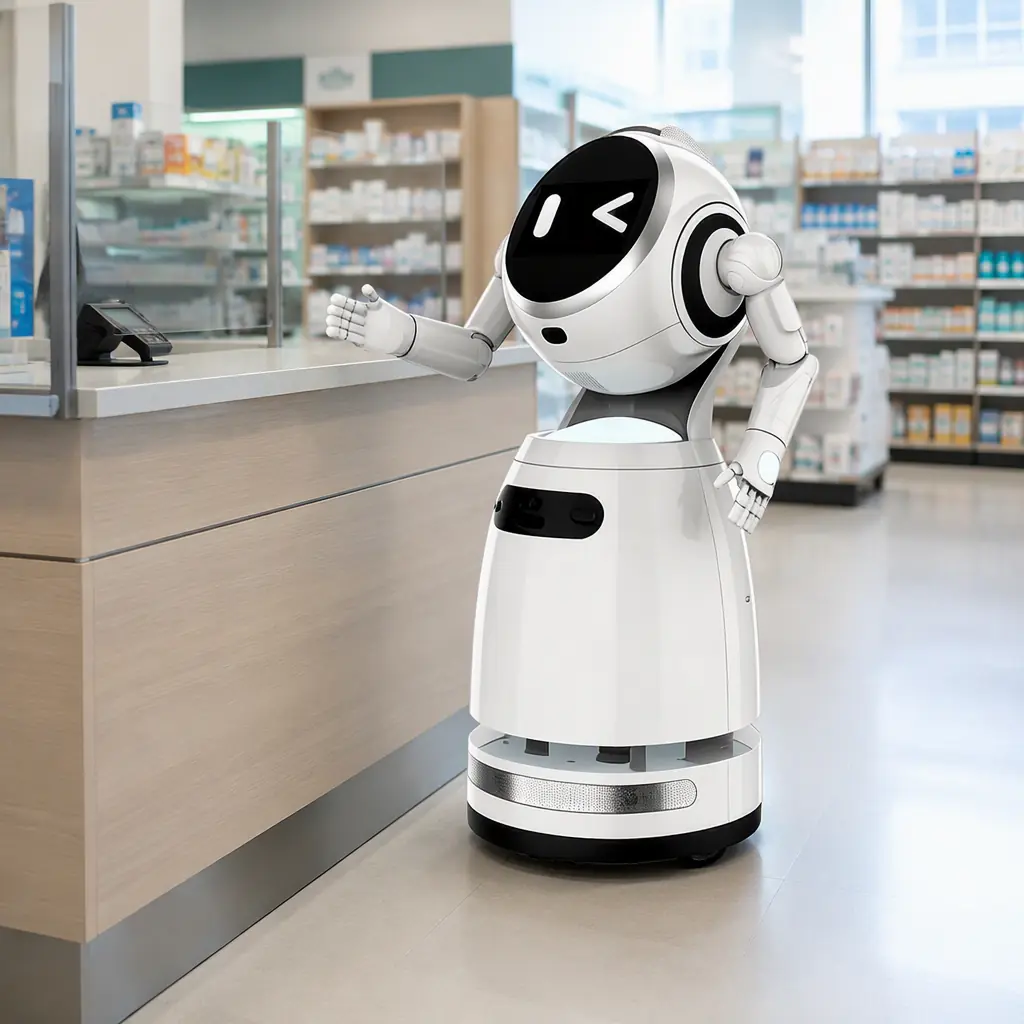
That privacy posture is the HIPAA-relevant design rule for pharmacy robots, and it is non-negotiable: the robot is a front-of-store service layer that never handles, displays or discusses patient information. The vendor evaluation framework includes the privacy-architecture checklist item; buyers should verify it in writing before piloting.
Space, Traffic and Staffing Math for a Typical Store
The deployment math for a retail pharmacy is compact enough to check on one page:
| Metric | Typical independent pharmacy | Chain store (CVS/Walgreens-class) |
|---|---|---|
| Store size | 3,000–6,000 sq ft | 8,000–14,000 sq ft |
| Daily prescriptions | 200–500 | 1,000–3,000 |
| Backroom-to-counter walks/day | 80–200 | 400–1,200 |
| Robot fleet | 1 delivery + 1 scrubber | 2–3 delivery + 1 scrubber |
| Technician hours returned/day | 4–7 | 12–25 |
The budget planning framework walks through the full cost comparison, and the RaaS models guide covers the subscription structure that fits pharmacy budgets — most independent pharmacies start with one delivery robot at $1,200–1,800 per month and add the scrubber in season two, when the walk-time savings have been documented in their own store. The change management playbook covers the staff dynamic: technicians are the first to defend the robot, because it is the first piece of automation that gives them back their feet — and pharmacists defend it because it keeps licensed work at the bench.
The retail pharmacy of 2026 runs on margin, regulation and minutes. The delivery robot takes the 90-meter walk off the technician's day, the scrubber takes the floor off the closing crew's night, and the humanoid takes the repetitive questions off the counter staff's shift — while the pharmacist, the license and the privacy boundary stay exactly where they belong. That is the automation pattern that works in a pharmacy, and it is the same pattern the multi-site deployment guide scales across a chain's portfolio: one store proves the route data, and the second store deploys in days.