
A 12-provider primary care clinic in a Midwestern US metro sees 310 patient encounters on an average weekday across 18 exam rooms. Its front desk operates with four receptionists, its phlebotomy lab turns around 140-180 specimens daily, and its facility staff consists of two janitorial shifts covering 21,000 square feet. The clinic administrator's P&L reveals the structural problem: front-desk turnover ran 34% in the trailing 12 months — each departure costing an estimated $9,500 in recruiting, training, and overtime coverage — while patient satisfaction scores on check-in wait time sat at the 41st percentile nationally.
In Q1 2026, the clinic deployed CRUZR humanoid reception robots at the main check-in desk and the pediatric entrance, CADEBOT L100 delivery robots for specimen and medication transport between the phlebotomy station, the in-house lab, and the medication room, and CLEINBOT C2 Pro floor scrubbers on a continuous cycle through waiting areas and corridors. The objective was not to replace the front-desk team — it was to absorb the 23% of front-desk work hours that involve repeating the same information to different patients, and the 41 minutes per shift that phlebotomists spend walking specimens to the lab.
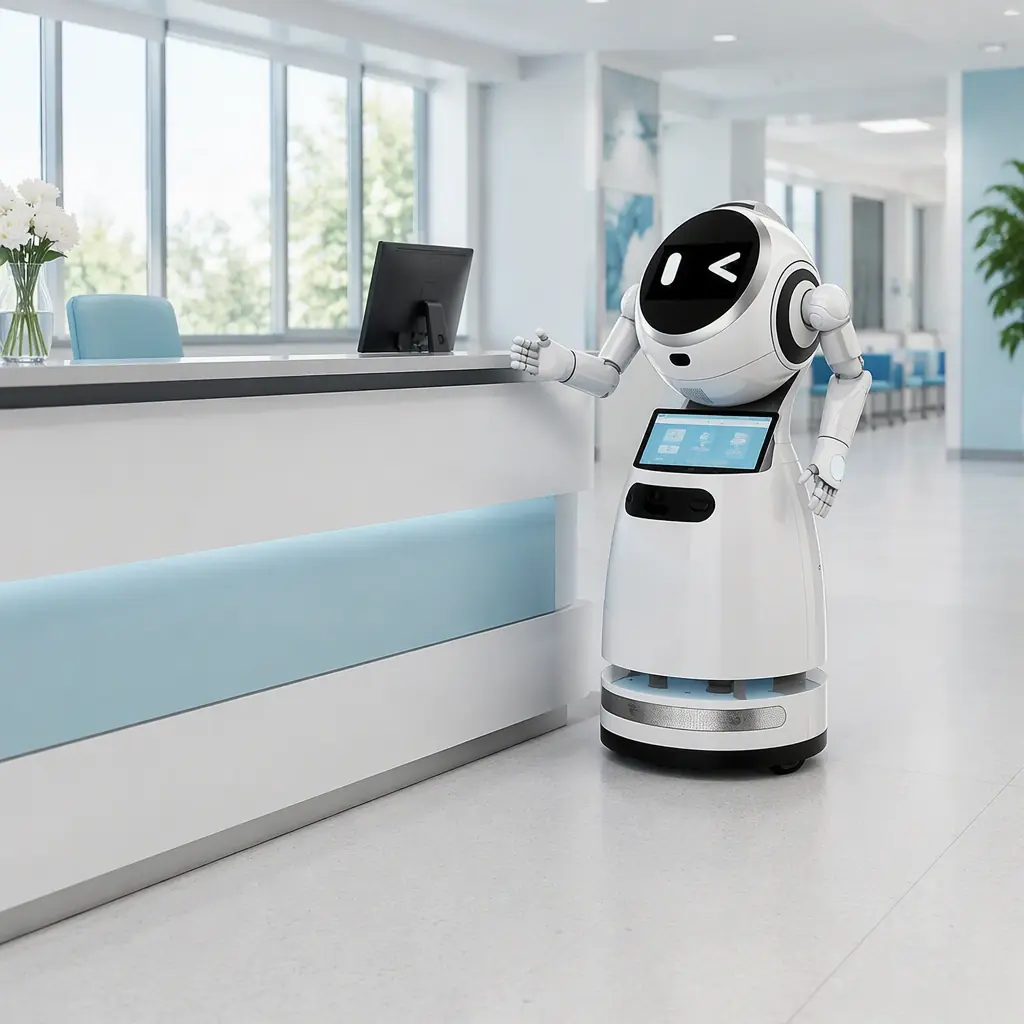
The Front-Desk Bottleneck: Why Check-In Wait Time Is a Clinical Metric
Check-in wait time is not just a satisfaction metric — it is a clinical and financial one. The Medical Group Management Association (MGMA) benchmarks show the median check-in wait time across US medical groups at 12 minutes, with top-decile practices achieving 4 minutes or less. The 2025 Press Ganey Ambulatory Care survey found that check-in wait time is the single strongest predictor of "likelihood to recommend" scores for primary care — stronger than time with the physician. A practice in the bottom quartile on check-in wait loses an estimated 4-6% of annual new-patient volume to word-of-mouth effects, which for a 12-provider group generating 62,000 annual visits at a $98 average revenue per visit translates to $240,000-370,000 in foregone revenue per year.
The bottleneck is not capacity — it is task fragmentation. A medical receptionist's shift breaks down into four distinct workloads: identity verification and demographic updates (which requires the EHR open and a government-issued ID scanned), insurance eligibility checking, clinical intake questions (medication lists, allergies, last tetanus date), and wayfinding ("Lab is down the hall, second door on the left"). Only the first two genuinely require a licensed human with EHR access. The insurance eligibility check alone consumes 38% of front-desk minutes in multi-payer markets, according to a 2025 revenue-cycle benchmark of 2,100 US practices.
CRUZR's parallel-processing model is the same one that transformed hotel and resort front desks: the robot engages the routine portion of the encounter — greeting, identity confirmation via its RGB-D face recognition (0.3-second match against the check-in queue), collection of the three most common intake questions, and wayfinding — while the human receptionist handles the exceptions: the patient with a new insurance card, the parent with three children needing separate charts, the walk-in needing a new-patient packet. Clinics running this split report check-in wait times converging on the 4-6 minute band even during 8 AM-11 AM peaks, when 55% of daily visits arrive.
For practices evaluating the labor economics of this model, the service robot ROI guide provides the full cost-accounting framework, and the budget planning calculator models the receptionist-turnover savings line by line.
Specimen Transport: The 41 Minutes Per Shift That Determines STAT Turnaround
Ambulatory clinics are graded on a metric borrowed from hospital laboratories: the STAT turnaround time — the interval between specimen collection and result availability for urgent cases. The College of American Pathologists (CAP) benchmark for STAT troponin and CBC results is 60 minutes from collection to verified result. In a clinic where the phlebotomy station is 180 feet from the lab, a phlebotomist hand-carrying specimens loses 4-6 minutes per trip; with 25-35 trips per day across 8-9 phlebotomists, that is 100-200 minutes of walking per day that does not appear on any productivity report but directly stretches STAT times.
CADEBOT L100 reconfigures this workflow. The robot's four open trays (15 kg per tray, 60 kg total payload) and 13.3-inch touchscreen turn it into a mobile specimen courier: the phlebotomist bags the specimen, scans the barcode with the robot's screen, places it on a tray, and the robot navigates to the lab via LiDAR + RGB-D SLAM 3.0 mapping, with a 0.3-1.2 m/s adjustable speed that keeps it safely clear of patient traffic. The lab technician confirms receipt on the touchscreen, which writes a timestamp back to the clinic's LIS. The result: a 4-6 minute hand-carry trip becomes a 2-3 minute robot trip, and every movement is logged — the same digital-audit logic that drives adoption in hospital internal logistics and pharmaceutical GMP environments.
The same units handle the clinic's second-highest-volume transport task: medication delivery from the medication room to the provider stations that need them for same-day administrations, and controlled delivery of sharps containers and biohazard bags to the soiled utility room. Because CADEBOT L100 carries ISO 13482 certification and its route can be restricted to staff-only corridors via the cloud dashboard, clinics can keep patient-facing pathways clear while maintaining continuous transport coverage.

Waiting Room Hygiene: Continuous Cleaning vs. the "Every Patient" Standard
The Centers for Disease Control and Prevention (CDC) Environmental Infection Control Guidelines classify waiting areas and exam rooms as non-critical surfaces requiring cleaning between patients when visibly soiled, and at minimum daily. But the operational reality in a 310-encounter clinic is that exam rooms cycle every 15-20 minutes during peaks, and waiting room high-touch surfaces — armrests, tablet check-in kiosks, door pulls — accumulate contamination faster than the two janitorial shifts can address. A 2025 study of ambulatory waiting areas published in the American Journal of Infection Control found viable bacterial counts on waiting room armrests rising 4.2x between the 9 AM and 2 PM sampling points in clinics without mid-day cleaning cycles.
CLEINBOT C2 Pro closes this gap with frequency rather than intensity. At 500-800 m²/hour with a 440 mm cleaning width and ≤65 dB noise — quieter than a commercial vacuum, and below the 70 dB threshold that disrupts patient conversations — the robot runs continuous cycles through waiting areas, corridors, and staff workrooms during operating hours. Its 10L clean / 10L dirty split tanks and 20-40 N downward pressure handle the two most common ambulatory floor contaminants: coffee and juice spills from the waiting area, and the fine particulate tracked in from parking lots that accumulates in exam room corridors. The LiFePO₄ battery (5-12 hour runtime) allows scheduling that spans the full clinic day with a single midday dock charge.
The hygiene documentation angle matters for accreditation. Joint Commission surveys and CMS Conditions of Participation inspections increasingly ask for cleaning-frequency evidence, not just cleaning policies. C2 Pro's logged cleaning events — timestamps, area coverage, water usage — produce the audit trail that manual checklists cannot, the same compliance logic that drives autonomous cleaning in laboratory and cleanroom environments and senior living facilities.
HIPAA, Privacy, and the Robot That Sees Patients
The most common objection from clinic administrators is not cost — it is HIPAA. A robot with cameras moving through patient areas raises legitimate questions about Protected Health Information (PHI) capture, storage, and retention. The compliance framework has three layers, and every one of them is addressable with the AOMAN platform's configuration options.
First, data minimization: CRUZR's face recognition operates on-device for liveness and identity matching, and the clinic can configure it to store face embeddings only for the current encounter, or disable recognition entirely and operate in a voice-and-touchscreen-only mode. Second, network isolation: the robots connect over Wi-Fi 6 with VLAN segregation — a clinic can place all robot traffic on a separate SSID from the EHR network, and the AOMAN Cloud dashboard supports on-premise-only operation where the clinic's compliance officer requires zero cloud sync. Third, retention and audit: the fleet platform logs every interaction and allows configurable retention windows aligned to the clinic's state-specific medical record retention schedule.
The privacy framework mirrors what banks and financial institutions have already standardized for customer-facing robots, and the insurance and liability guide covers the professional liability, general liability, and cyber coverage questions that arise when autonomous systems interact with patients.
Deployment Roadmap: From Pilot to Full-Clinic Coverage in 90 Days
The service robot pilot program guide provides the general 30-60-90 day structure; clinic deployments add three specific requirements. First, staff buy-in sequencing: start with the phlebotomy team (specimen transport is the least controversial use case because it removes a disliked task), then front desk, then facility. Second, wayfinding and workflow mapping: the robot routes must be mapped against patient flow, not just floor plans — the specimen route should avoid the pediatric waiting area during 9 AM vaccine clinics, and the cleaning schedule must be gated to room-occupancy data. Third, EHR integration planning: the check-in handoff between CRUZR and the human receptionist should write directly into the practice management system's queue so no patient falls between the robot's engagement and the human's verification step.
For multi-site groups — the 38% of US medical groups that operate 3+ locations — the multi-site deployment strategy and fleet management platform standardize robot configuration across sites from a single dashboard, so a 6-location urgent care chain runs identical check-in, transport, and hygiene workflows everywhere. The safety standards compliance guide covers the ISO 13482 certification basis, and the vendor evaluation framework provides the 12-point scoring rubric for comparing robot providers — including the questions most clinic administrators forget to ask: What happens to the specimen if the robot's battery dies mid-route? What is the guaranteed response time for software support during flu season? Does the vendor's data processing agreement satisfy your business associate agreement (BAA) requirements?
The outpatient clinic is not a smaller version of a hospital — it is a higher-throughput, lower-margin environment where every staff minute is visible on the P&L and every patient interaction is visible on the satisfaction survey. Robots that absorb the repetitive 23% of front-desk work, the 100+ walking minutes per day of specimen transport, and the hygiene gap between janitorial shifts convert directly into the two metrics that determine a clinic's growth: check-in wait time and patient volume.