
Service Robot Warranty Claims and the RMA Process
At a glance: Every procurement contract promises warranty coverage. Very few operators know, before the first failure, how a warranty claim is actually made, who pays for the site visit, how long the replacement takes to arrive, and which paperwork the supplier can use to refuse the claim. The gap between warranty as a clause and warranty as a working process is where fleet owners lose money. This guide sets out the RMA flow for a service robot fleet, the evidence each step requires, and the documentation discipline that keeps a legitimate claim from being rejected on a technicality.
The Clause in the Contract Is Not the Process on the Floor
Warranty coverage is agreed in negotiation and invoked in an inconvenient moment: a unit has failed mid-shift, a corridor is uncovered, and someone has to make a claim against a supplier who is not on site. The operator who has a written RMA process recovers the unit on a predictable timeline; the operator who does not spends the first day finding out who to contact and the rest of the week arguing about freight. The clause sets the entitlement; the process determines whether the entitlement converts into a working robot.
This is the operational counterpart to the commercial terms. What the contract promises — coverage windows, response times, wear-part exclusions, service credits — is the subject of the warranty contract terms guide. This article assumes those terms are agreed and answers the next question: once a unit is in the field and fails, what is the sequence, and what evidence protects the claim.
Two costs are almost always disputed and should be settled before the first claim. The first is the field call: does the supplier send a technician, and is that labour inside or outside warranty. The second is the freight: who pays to move a failed unit to the workshop and a repaired or replacement unit back, and on which carrier and timetable. An RMA request that has to negotiate these two points on every incident is an RMA process that is not finished.
The RMA Flow, Step by Step
A service robot RMA has five stages, and each one has a specific evidence requirement. Skipping a stage is the most common reason a claim is delayed or refused.
| Stage | Action | Evidence captured | Owner |
|---|---|---|---|
| 1, Detection and triage | Confirm the fault is not a known operating error; classify severity | Fault code, timestamp, photograph, incident ID | On-site operator |
| 2, Remote diagnosis | Supplier reviews logs and attempts a remote fix before a site visit | Log export, remote session record | Supplier support |
| 3, RMA authorisation | Supplier issues an RMA number and decides replace, repair, or field-repair | RMA number, decision, agreed freight terms | Supplier, operator confirms |
| 4, Reverse logistics | Failed unit shipped or field-repaired; replacement dispatched per terms | Dispatch note, carrier tracking, swap record | Both parties |
| 5, Diagnosis and closure | Workshop root-cause; warranty or chargeable decision; defect fed back | Diagnosis report, closure notice, billing decision | Supplier |
The pivotal stage is the third. Until an RMA number is issued, the operator is storing a broken robot and, in many contracts, no clock has started. Escalate if the RMA number is not issued within the response window the contract promises, because a claim that sits without an RMA is a claim that will later be disputed. The escalation mechanics — named contacts and clock times — are the same discipline used in the incident response runbook.
Evidence: The Four Things That Decide a Claim
Suppliers refuse claims on evidence gaps far more often than on genuine coverage disputes. Four records decide the overwhelming majority of cases, and all four are cheap to capture at the moment of failure.
- The fault code and log export. Modern service robots log faults, and the log is authoritative. A claim submitted with a log export and the exact failure timestamp is diagnosed in the workshop before the unit arrives; a claim submitted with a verbal description arrives as an open question.
- A timestamped photograph. Damage claims — a cracked housing, a bent sensor bracket, a swollen battery — hinge on condition at the point of failure. Photograph the unit in place before it is moved, including the serial plate.
- The in-service and maintenance record. The supplier will check whether the unit was maintained on schedule and used within its rated duty. If the preventive maintenance log is incomplete, a wear-related failure becomes arguable. The interval arithmetic for that schedule is in the preventive maintenance guide, and keeping it current is what protects the claim.
- The operator error record. If a fault traces to misuse — a unit driven outside its rated environment, an overridden sensor — the supplier will say so. An operator who has trained and certified staff, as described in the training and certification guide, has a defensible answer.
Repair, Field-Repair, or Replace: Who Decides
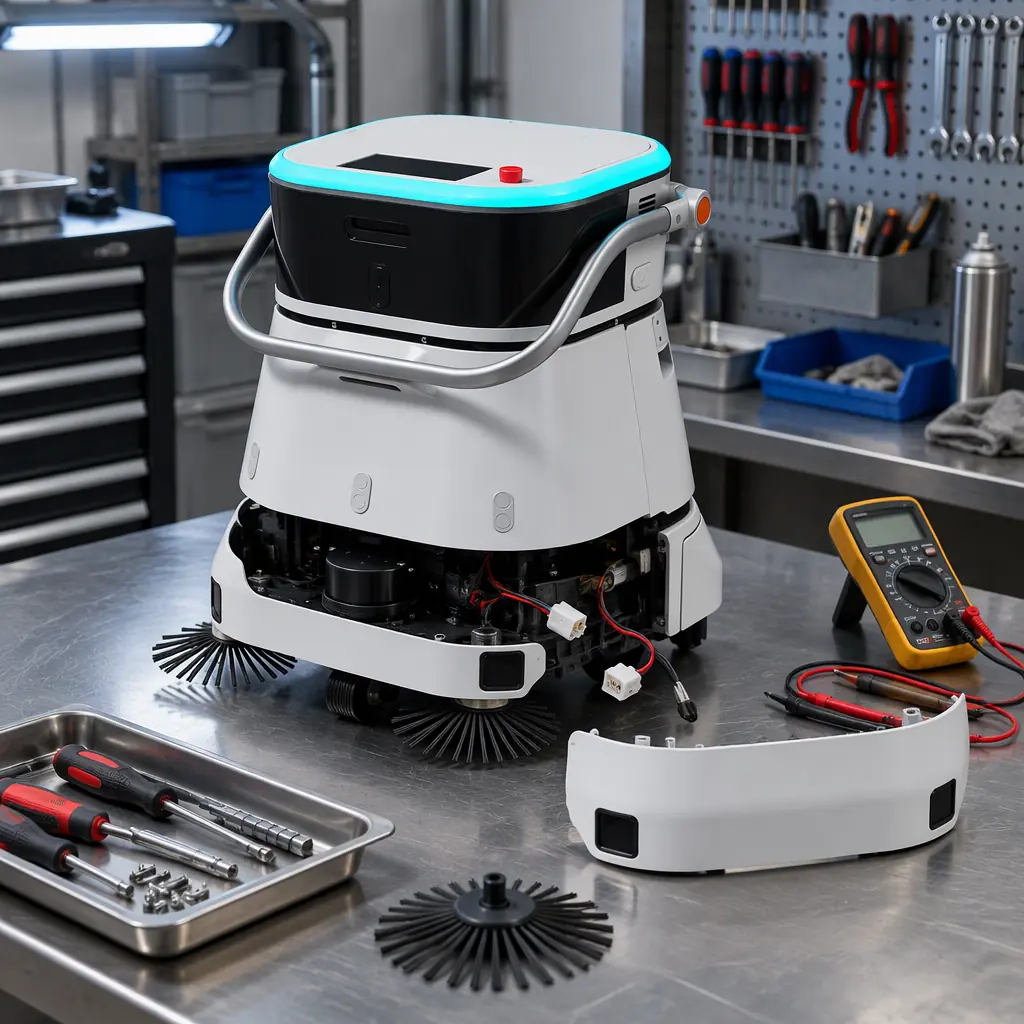
The supplier decides the remedy, but the contract should constrain how. Three outcomes are possible, and the operator's interest is to know which applies before the unit leaves the site.
A field-repair keeps the unit in place and is the fastest outcome where the fault is accessible — a sensor swap, a wheel assembly, a charging contact. It depends on the supplier carrying the part and having a technician in the region. A bench repair means the unit travels to a workshop; the operator's exposure is the transit time plus the repair time, during which the unit is unproductive. A replacement is the outcome the operator wants on a critical-unit failure, and it should be written as a trigger rather than a favour: for example, replacement when the diagnosis is not complete within a stated window.
The remedy decision interacts directly with fleet sizing. A fleet with adequate overdensity can absorb one unit in transit without a coverage gap, which is precisely why spare-unit planning is a warranty-strategy decision as much as a capacity decision. The redundancy arithmetic is set out in the spare-unit and depot planning guide.
| Scenario | Preferred remedy | Operator exposure |
|---|---|---|
| Single failed sensor, part in region | Field repair | Hours; unit stays on site |
| Drive or battery fault, workshop required | Bench repair with swap | Transit + repair; mitigated by a spare unit |
| Repeat fault on the same unit | Replacement, not another repair | Escalate: a unit that fails twice on one root cause is a candidate for replacement or refund |
| Fleet-wide defect pattern | Field campaign or recall | Contract event, not an RMA; see the fleet defect clause |
The last row is the one operators underestimate. When several units fail on the same component, the right instrument is a fleet-wide defect notice to the supplier, not a series of individual RMAs. A single claim is a repair; a pattern is a campaign, and campaigns are negotiated at contract level, not at the service desk.
What to Track So the Next Claim Is Faster
The RMA process improves only if its timings are measured. Four figures per month are enough, and they mirror the incident metrics used elsewhere in the operation.
- Time to RMA number: from fault detection to the supplier issuing an RMA. This is the supplier's responsiveness metric.
- Time to remedy: from RMA to the unit productive again. Track field-repairs and bench-repairs separately; mixing them hides the transit problem.
- Warranty acceptance rate: the share of claims accepted as warranty rather than chargeable. A falling rate is a signal to review use, maintenance records, or the contract's wear-part definitions.
- Cost per claim: including any freight and outages the operator absorbed. This is the number that tells finance whether the warranty is worth what was paid for it.
None of this is exotic. It is the same logging discipline the fleet already needs for uptime and utilisation, applied to failure. The operator who records fault codes, photographs, and maintenance logs as a matter of routine makes every warranty claim faster and every disputed claim more winnable.
To review warranty and RMA terms against your fleet's operating profile, send us the details through the enquiry form and we will map the process to your sites.

Get a Quote
Tell us about your space and workload, we reply within 24 hours.