
Cleaning Robot Night Shift Scheduling, The Utilization Arithmetic Behind Off-Hours Programs
At a glance: A night-shift robot programme is sold on the idea that the building is empty and the machine has eight uninterrupted hours. In practice a third of that window is unavailable, and the loss is predictable. Here is the arithmetic, the dock-count constraint most sites get wrong, and a schedule that fits the ceiling.
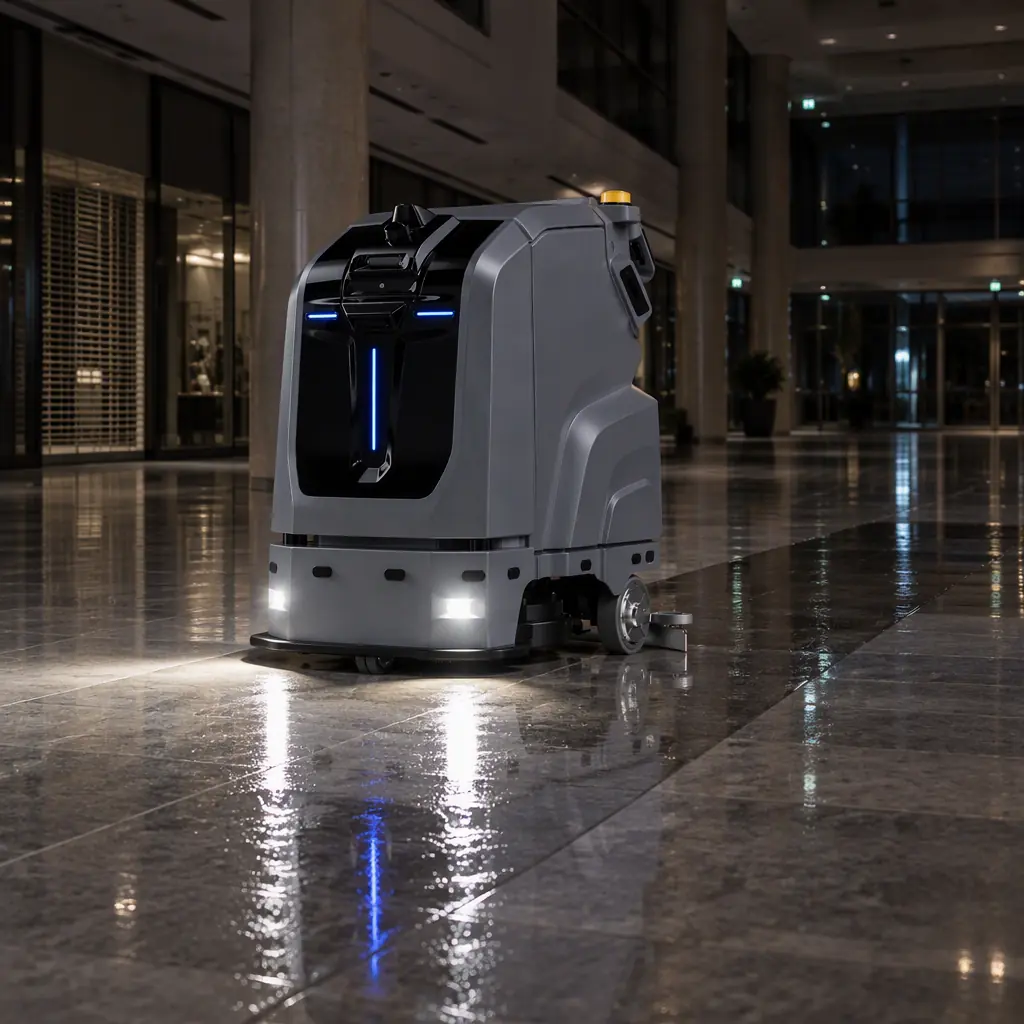
The Billable Window Is Not Twenty-Four Hours
Every night-shift business case starts from the same assumption, that an autonomous unit can work the whole dark period. A site that runs a twelve-hour night window therefore assumes twelve productive hours. The real figure is closer to seven or eight, and the gap is not a defect. It is the physical cost of owning a battery-electric machine that must return to a dock, and of a building that does not hand over every zone at the same moment.
Three losses sit between the clock and the clean floor.
Charge duty cycle. A unit that runs for three hours and charges for roughly one has already given up a quarter of the window. Industrial floor scrubbers in this class commonly hold 120 to 180 minutes of run time at working load, with recharge from a depleted state taking 90 to 150 minutes on a standard dock. That ratio, not the shift length, sets the ceiling.
Travel and setup. A robot that finishes zone A and must cross to zone B spends that crossing not cleaning. In a building with separated wings or multiple lift cores, transit overhead of 8 to 15 percent of the shift is normal, and in a badly mapped site it can exceed 20 percent.
Zone access windows. Some areas are not truly available at night, a loading dock taking early deliveries from five in the morning, a security-controlled area requiring an escort, a kitchen handed over only after the last close-down check. Each restricted zone shortens the effective window independently of the robot's capability.
The practical method is to build a timeline rather than take the shift length at face value.
| Segment of a 12-hour night window | Typical duration | Productive? |
|---|---|---|
| Zone handover and route start | 20 to 40 min | No |
| First cleaning run | 150 to 180 min | Yes |
| Return to dock, charge | 90 to 150 min | No |
| Second cleaning run | 150 to 180 min | Yes |
| Inter-zone transit and lift waits | 50 to 110 min | No |
| Restricted-zone exclusion | 60 to 120 min | No |
Add the productive rows and the twelve-hour window yields roughly five to six hours of actual cleaning per unit. Buyers who skip this step size a fleet for twelve hours of work and staff a fleet for six, then conclude a year later that the machines underperform. They do not. The plan was wrong.
Working the Night Shift, What Actually Constrains Throughput
Once the losses are visible, three levers control night throughput. They are ranked below by how much they return for the effort.
The charging ratio, addressed by dock count rather than battery size. The instinct is to buy a bigger battery. The cheaper fix is usually more docks. A unit that can charge opportunistically during a mid-shift break, or hand over to a second unit on a shared dock, loses far less of the window than a unit dragging a larger pack around all night. If a five-unit night fleet shares two docks, the queue becomes the constraint; provisioning one dock per unit, or one per unit plus a spare, removes it.
Route ordering to minimise transit. Sequence zones so the robot finishes near where it must dock or where the next zone begins. A route that ends on the far side of the building from the charger spends the last forty minutes of the shift travelling instead of cleaning. This costs nothing to fix and is the single most common scheduling error.
The discussion of wasted capacity in the scheduling and building-system integration guide puts the figure at 30 to 40 percent of available capacity on a standalone fixed schedule. The timeline above explains where that number comes from, and the fix is the same, which is to stop treating the shift as a single block.
Zone-level priority instead of full-building coverage. Not every area needs the same frequency. Entrance lobbies, food courts and washrooms justify nightly treatment. Perimeter corridors on the fourth floor do not. Running the whole building nightly exhausts the window on low-value floor area and leaves high-traffic zones on a rushed pass.
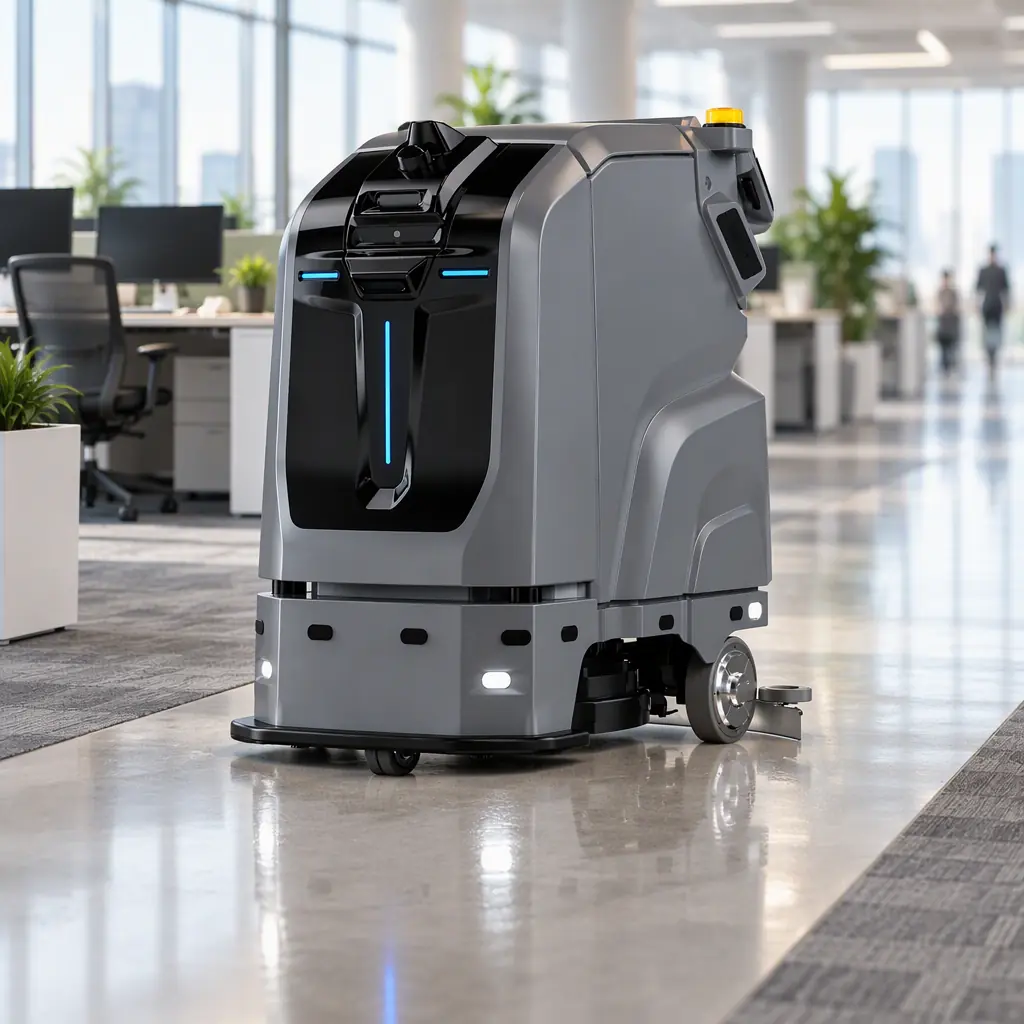
The Daytime Alternative Nobody Costs Properly
Running the fleet during operating hours keeps utilisation high and removes the charge-window problem almost entirely, because the robot can dock in the middle of a long day without anyone noticing. That is the honest advantage of daytime cleaning, and it is real.
What the daytime case usually understates is supervision. A robot working a floor with visitors, trolleys, dropped glass and children moves at a different risk profile from one working an empty atrium. Three costs appear that a night programme does not carry.
Public interference handling. Curious occupants step in front of the machine, ride its path, or attempt to redirect it. Someone must be able to clear that, on a wired response time, not whenever a supervisor happens to be nearby.
Collision and near-miss documentation. Any site with an insurer and a safety committee will want incident records. Daytime operation generates them; night operation largely does not.
Noise and proximity constraints. A scrubber near occupied desks, consultation rooms or dining seating may need a reduced-power or silent mode that is slower per square metre. The machine is running, but not at the throughput the specification sheet implies.
Daytime cleaning is not worse. It is a different cost structure, and the arithmetic should be run on it rather than dismissed. For sites where the night window is unusually generous because the facility already runs a skeleton overnight crew, the night programme usually wins on cost per square metre. For sites with a short dark period and heavy daytime footfall, a hybrid is often better.
The Hybrid Schedule, Split-Shift Deployment
The schedule that performs best across most commercial buildings is neither pure night nor pure day. It splits by zone value and occupancy, and the split is straightforward to define once the building is mapped honestly.
| Zone type | Recommended cycle | Reason |
|---|---|---|
| Entrance lobbies, atriums | Night, nightly | Highest visibility, empty building, full-width passes possible |
| Food courts, cafeterias | Night, nightly | Heavy soil load, needs full clean after close |
| Washrooms, waste rooms | Night or pre-open | Access controlled, best done before occupants arrive |
| Back-of-house corridors | Night, alternate nights | Low visibility, tolerates reduced frequency |
| Office floors, open plan | Daytime, mid-morning lull | Catches crumbs and spill during the day, dock-friendly |
| Retail or dining frontage | Daytime, quiet hours | Spill response matters more than deep clean |
| Loading docks, service yards | Fixed early-morning window | Availability dictated by delivery schedule, not the robot |
A split schedule also smooths demand on the dock. Night loading concentrates the charge demand in a few hours, which matters for the electrical supply sizing question, while a day cycle spreads it. Sites that combine the two often need less charging infrastructure than a pure-night plan of the same fleet size, which is a genuine capital saving rather than a rounding error.
Build the split against the multi-floor deployment constraints rather than floor area alone. Lift availability is the binding constraint in almost every multi-storey site, and it changes between night and day, because at night the robot competes with nobody and during the day it competes with everyone.
How Do You Calculate Real Robot Utilization?
Divide productive cleaning hours by the total hours the site is available for cleaning, then subtract non-productive time within the window. In a typical twelve-hour night programme a single unit delivers five to six productive hours, an utilisation of roughly 45 to 50 percent. Measure against that band, not against the shift length, and a fleet that appears to be underperforming will usually be performing exactly as the schedule allows.
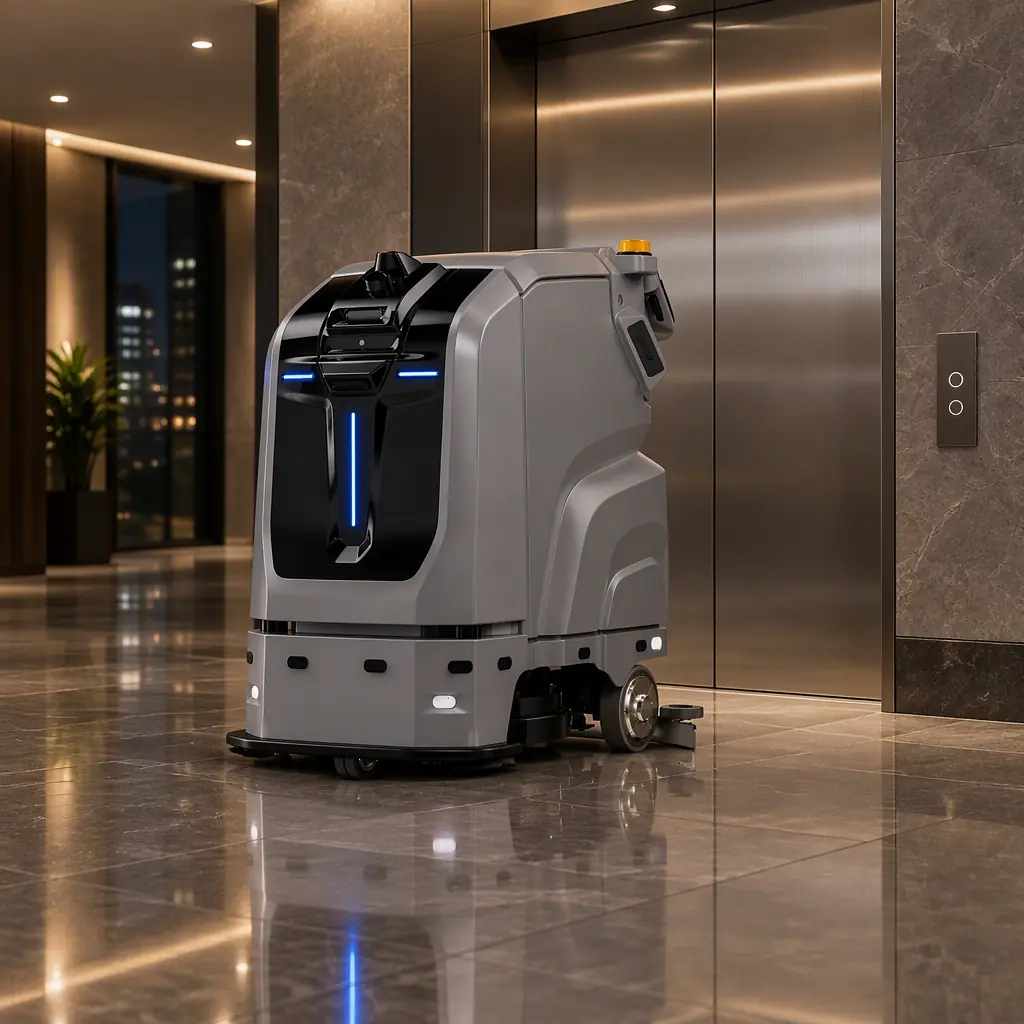
Scheduling Around Multi-Floor and Elevator Constraints
The lift is where night schedules quietly break. A robot that must travel between floors waits for a lift, and during the day that wait can be several minutes per trip. At night the wait collapses to seconds, which is precisely why multi-floor night programmes often work better than daytime equivalents despite the charge-window loss.
Two practical points determine whether the advantage is captured.
Lift integration is not optional above three floors. A unit that cannot call a lift and confirm it has arrived will either wait indefinitely or require a human escort at every transition. Both outcomes destroy the schedule. Where integration exists, the scheduling logic should reserve a lift for the fleet during the night window, which a building management system can usually accommodate outside hours at no cost.
Sequence floors to avoid return trips. Do floor six, then five, then four on the way down, and never send a unit back up mid-shift for a missed zone. A single mid-shift return journey across ten floors can consume twenty minutes of the window for one small area, which is the same time it would have taken to clean two full corridors.
Compare the resulting plan against the utilisation targets in the 2026 service robot KPI benchmarks before committing. A schedule that does not clear the benchmark band on paper will not clear it in service, and the shortfall shows up as an argument about hardware rather than about planning.
Sizing the Fleet, Not Just the Schedule
The floor area to be covered, divided by the realistic productive hours per unit, gives a fleet size. A site with 40,000 square metres of cleanable area, a machine that covers 2,000 square metres per hour, and six productive hours per unit per night needs roughly four units before accounting for restricted zones and the reduced productivity of silent mode near occupied areas. Add one for redundancy, because a fleet with no spare loses an entire zone whenever a single unit is on a scheduled service.
Establish the productive-hours figure during a pilot rather than accepting a vendor estimate, and log the losses by category so the schedule can be tuned. The pilot programme method covers how to structure that measurement. The labour baseline to compare the result against, including the parts of a cleaning budget that do not disappear when robots arrive, is set out in the cleaning robot labour cost model.
AOMAN's C1 large-format scrubber is built for exactly this split-shift pattern, with dock-to-dock scheduling as a first-class operational mode rather than an afterthought. The cleaning robot range covers both the large-format and compact classes so a site can match machine to zone instead of forcing one platform across the whole building.
Before finalising dock provisioning, check the achievable charge window against the shift structure. Sites that run a pure night programme and a shortened one, such as a five-hour window between close and early deliveries, frequently need more docks than units, while a daytime or hybrid pattern needs fewer. Getting that ratio right is worth more than any single machine upgrade.