How Service Robots Are Transforming the Hospitality Industry in 2026
At a glance: AOMAN D1 carries up to 40 kg per run across four trays, and clears a 70 cm aisle. This guide maps the delivery, cleaning and guest-guidance roles that hospitality operators deploy first, and the infrastructure each one needs.
Hospitality runs on repetitive, timed work: trays and towels moving between floors, public areas being reset on a schedule, and guests asking the same twelve questions at the front door. Automation fits where that work is predictable -- so the first question for an operations director is which layer to robotize first, not whether to robotize at all.
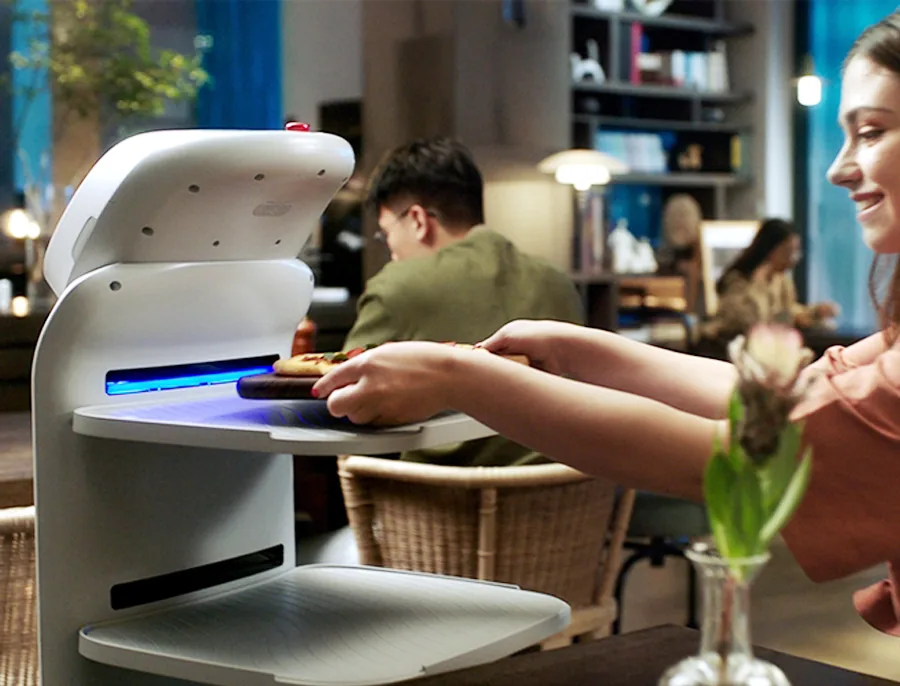
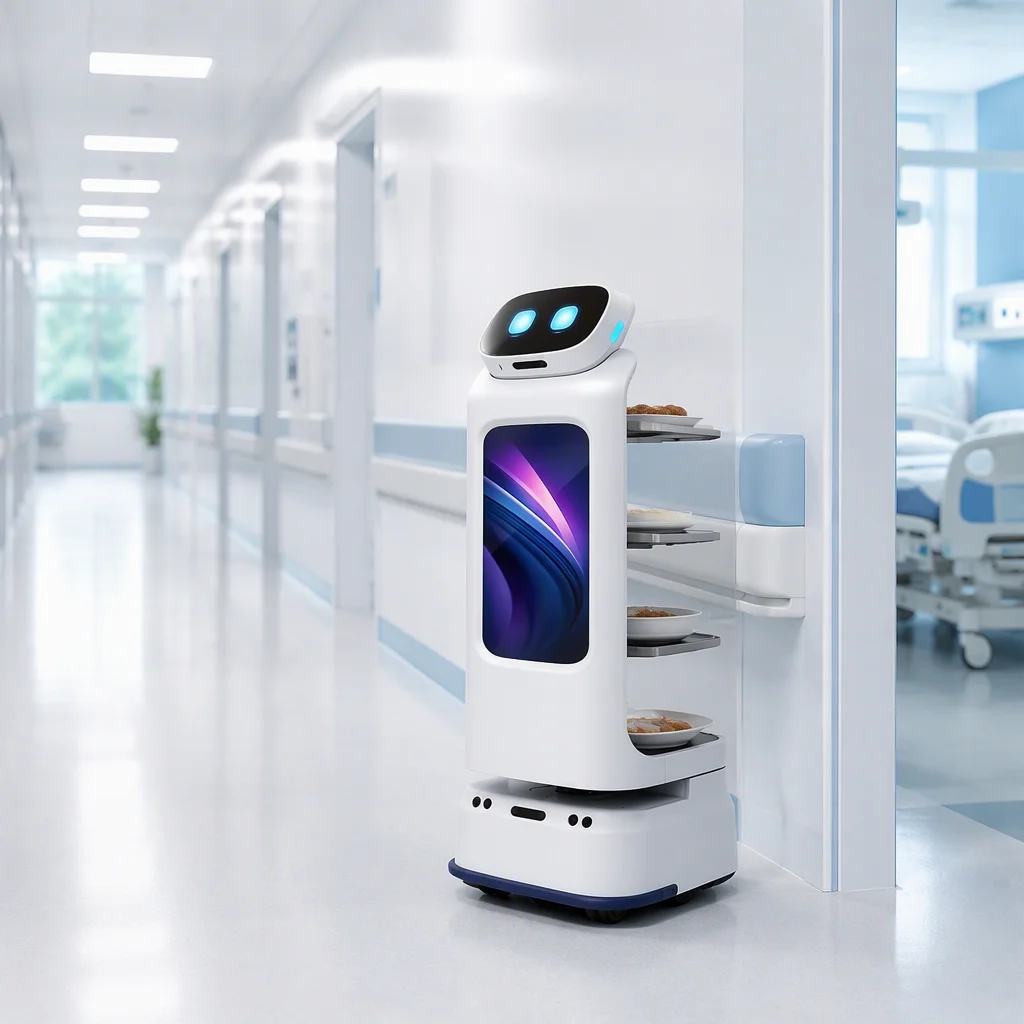
The AOMAN D1 delivery robot carries up to 40 kg across four load trays and clears aisles as narrow as 70 cm -- enough to handle a full room-service tray plus amenity bundles on one run, and narrow enough for most hotel corridors and kitchen aisles. That combination of payload and footprint is why delivery usually comes first: the task is high-frequency, geometrically simple, and measurable from day one.
This guide covers the three robot roles that see real production use in hospitality -- delivery, cleaning, and guest guidance -- then the infrastructure and scheduling decisions that decide whether a deployment is still useful at month six.
Delivery robots: what 40 kg buys you
One run, several stops
Four trays on one chassis changes how a property plans deliveries. Instead of one runner, one tray, one room, a unit can take a breakfast order, a towel pack, and a minibar refill in the same loop and drop each at the right door. Route planning and obstacle handling run on pre-mapped layouts: the SLAM-based navigation stack builds and refreshes the map automatically, and depth sensors keep the unit courteous around luggage carts and housekeeping trolleys.
Where delivery pays off first
- Room service and in-room dining -- peak windows (breakfast, late evening) are where the queue forms; four-tray runs spread that load.
- Amenity and linen runs -- towels, pillows, adapters, and minibar refills are small, light, and zero-interaction; ideal overnight work.
- Kitchen-to-table service -- the last stretch of a plate's journey, in hotel F&B outlets and conference kitchens.
- Files and small materials -- business hotels use the same unit for documents and meeting-room supplies during the day.
A delivery loop, minute by minute
- Load (1-2 min) -- the kitchen or housekeeping shelf stages by destination; the unit carries four trays, so the staging point sorts by floor.
- Dispatch (0-1 min) -- the fleet manager assigns the loop from the property's order data; the robot takes the next loop as soon as it docks.
- Elevator and transit (2-4 min) -- the bridge calls the car and confirms arrival; the robot travels at walking speed with audio cues in corners.
- Door (1 min per stop) -- notification, wait window, next stop; if nobody answers, the protocol returns the item rather than parking it.
- Return (2-3 min) -- back to staging or to dock, whichever the queue says.
The useful discipline here is what the loop reveals: the only variable a property controls is staging discipline and elevator responsiveness. Those two are the pilot's real test.
Elevator integration changes the arithmetic
A delivery unit confined to one floor serves only a fraction of a mid-rise property. The fleet manager needs to call the elevator, select the floor, and confirm arrival -- typically through a dry-contact or BACnet/IP bridge to the building's elevator controller. Properties with older wiring should budget that work into the pilot rather than assume the robot will just handle it.
Small-format proof points
In a publicly documented deployment in Japan, a ramen chain in Kyushu uses AOMAN D1 units for kitchen-to-table carries -- the same loop mechanics a room-service run needs, in a tighter footprint.
Cleaning robots: floors that match the brand standard
Public-area floor quality is the most visible operational metric in hospitality, and overnight is when the property has the space to reset it. The AOMAN C1 scrubs at 2,040 m² per hour with dual 70 L and 50 L tanks and a 790 mm squeegee deck -- enough to cover a lobby, reception zone, and F&B corridors inside a standard overnight window while it re-docks for a water change. Its 85 cm aisle clearance covers the service doors that sit on most cleaning routes.
For tighter spaces -- banquet prep areas, back offices, treatment rooms -- the AOMAN C2 Pro is the fit: compact enough to pass under a 70 cm desk, quiet enough to run during an office day, and built on modular water tanks so refills happen on site.
| Time | Zone | Unit |
|---|---|---|
| 10 PM - 2 AM | Lobby, reception, F&B outlets | AOMAN C1 |
| 2 AM - 5 AM | Guest-floor corridors and elevator lobbies | AOMAN C1 |
| 5 AM - 7 AM | Conference foyers, meeting floors | AOMAN C1 |
| Afternoon lull (3 - 5 PM) | Restaurant and bar floors, tight back areas | AOMAN C2 Pro |
The consistent part matters as much as the speed: a machine repeats the same pattern and logs it, so engineering and housekeeping can audit coverage in square meters instead of by memory.
Guest-facing robots: the G1 in the lobby
Guest-facing guidance is the role that shapes how a property talks about its robots, so it should be handled by a unit designed for it. The AOMAN G1 carries 15 degrees of freedom for natural gesture, a six-microphone array with 5 m pickup, and a 13 MP camera -- aimed at multilingual welcome, orientation, and check-in assistance rather than transport. It returns to its dock to recharge automatically, so it is standing in the lobby when the first guests arrive.
- Orientation and directions -- rooms, restaurants, meeting floors, and local attractions, with look-up rather than guesswork.
- Check-in queue triage -- handles the shortlist questions from a queue of arrivals so desk staff see the guests who actually need them.
- Escort duties -- guiding guests to a venue or a meeting room inside a property or a convention center.
- Absorbing repetition -- WiFi passwords, amenity hours, and booking questions get the same answer every time; anything complex escalates to a human.
In a publicly documented deployment in Japan, a G1 works orientation duty in a museum in Osaka -- the same pattern of scheduled, multilingual guidance that a lobby deployment uses.
The infrastructure checklist
- Elevator integration -- confirm the bridge option before committing to multi-floor routes.
- Coverage -- WiFi for call-home telemetry in every corridor the robot uses, and a stable dock location with power.
- Map maintenance -- furniture moves and renovation phases should trigger a map refresh, not a long period of bad routes.
- Human ownership -- a robot champion per shift who handles docks, swaps, and first-line troubleshooting.
- Guest communication -- signage and front-desk briefings convert surprise into curiosity; properties that explain the robots up front see better acceptance.
On the paperwork side, request the standard set before buying: ISO 9001 quality-management documentation, the CE and applicable FCC declarations for the regions you source for, RoHS compliance for the electronics, and UN38.3 transport documentation for the battery. A vendor that ships these without being asked is a vendor that has done this before; a vendor that fronts it against the order is a signal worth noting.
A first month that answers the real questions
A pilot should be scoped to answer four questions, in order.
- Does the map hold? Week 1: run the unit through every corridor and dock it on schedule. Every surprise here is cheaper than a surprise in month four.
- Does the elevator bridge hold? Week 2: push it through the peak period of an average day, no exceptions.
- Does the staffing hold? Week 3: run without a shadow, observe the champion shift, and note where the unit is cleared out of the way by staff rather than used.
- Does the guest reaction hold? Week 4: positioning, noise, and route behavior near guests; adjust before hiding the evidence of a bad week.
If week four is still a struggle, the answer is a configuration problem -- layout, staging, or dock placement -- and it is solvable before you commit to fleet numbers.
Which robot for which job
| Task | Recommended unit | Key numbers |
|---|---|---|
| Room service, amenity, file delivery | AOMAN D1 | 40 kg, four trays, 70 cm aisle |
| Lobby, corridor and F&B cleaning | AOMAN C1 | 2,040 m²/h, 70 L + 50 L tanks, 790 mm deck |
| Compact indoor cleaning | AOMAN C2 Pro | 70 cm desk clearance, quiet, modular tanks |
| Guest guidance and check-in assist | AOMAN G1 | 6-mic array, 5 m pickup, 13 MP camera |
From pilot to fleet
The standard path is one role first -- usually delivery -- then cleaning once routes and dock placement are proven, then guest-facing units once teams trust the operational rhythm. Properties moving through all three typically start at the hospitality solutions area of this site, where the deployment playbook matches property type.
Define the success metrics before the pilot ships, not after: delivered loops per day, minutes to the door during peak windows, square meters of logged cleaning coverage, and staff hours actually relieved (compare against the baseline you pre-agreed with the department heads). Without that set, a pilot produces impressions -- and impressions are not a renewal decision.
Tell us your floor plan, guest floor count, and current delivery volumes -- contact our deployment team for a pilot scoping. We will tell you honestly which role fits your property first, and which one to skip. The zone-by-zone routing and cycle-time side of the same decision is worked through in the cleaning labour cost model.