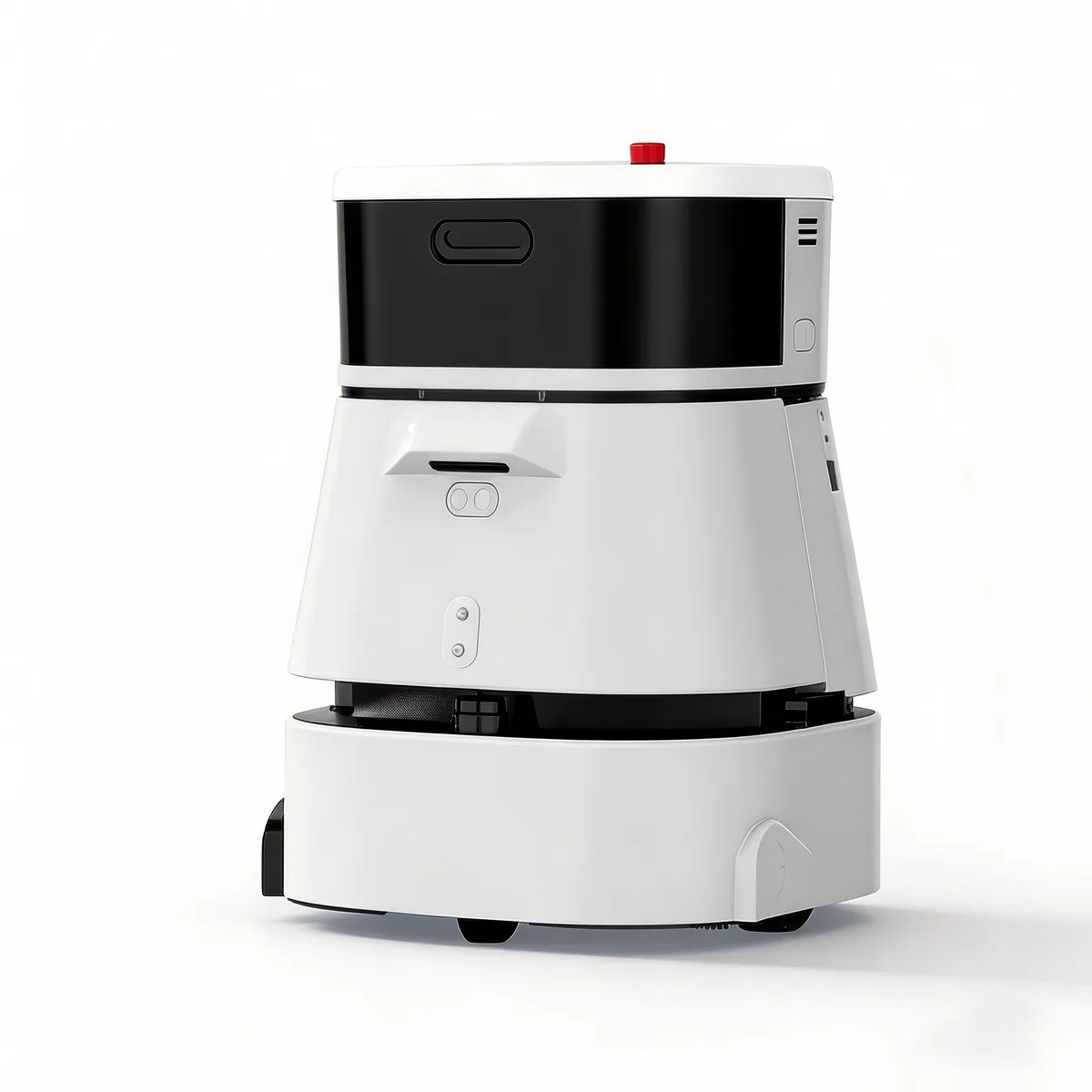
A career fire station in Tulsa, Oklahoma, runs three shifts of four firefighters on a 24-on/48-off rotation. The station's apparatus bay holds two engines and a ladder truck under a 60-foot-wide high-bay roof, the living quarters include a dormitory, dayroom, kitchen and fitness room, and the station hosts an average of 40 community visitors a week — school groups, scout troops and neighborhood associations — for station tours and fire-safety education. A station captain's time study found that facility upkeep consumed 2.4 crew-hours per shift: sweeping the bay floor before inspections, mopping the dayroom after the night crew's meal, cleaning the dormitory corridor, and resetting the training room between tour groups.
The problem is not that firefighters refuse to clean — it is that every hour of facility upkeep is an hour pulled from the station's actual mission. The National Fire Protection Association's staffing research shows that companies average 20-30 calls per day in busy urban districts, and between calls the crew's priorities are training, apparatus checks, gear maintenance and rest. The stations winning the facility-management battle in 2026 are automating the cleaning layer entirely, and the deployment pattern follows the station's three zones: the bay, the living quarters and the public face.
The Apparatus Bay: An Outdoor Problem Indoors
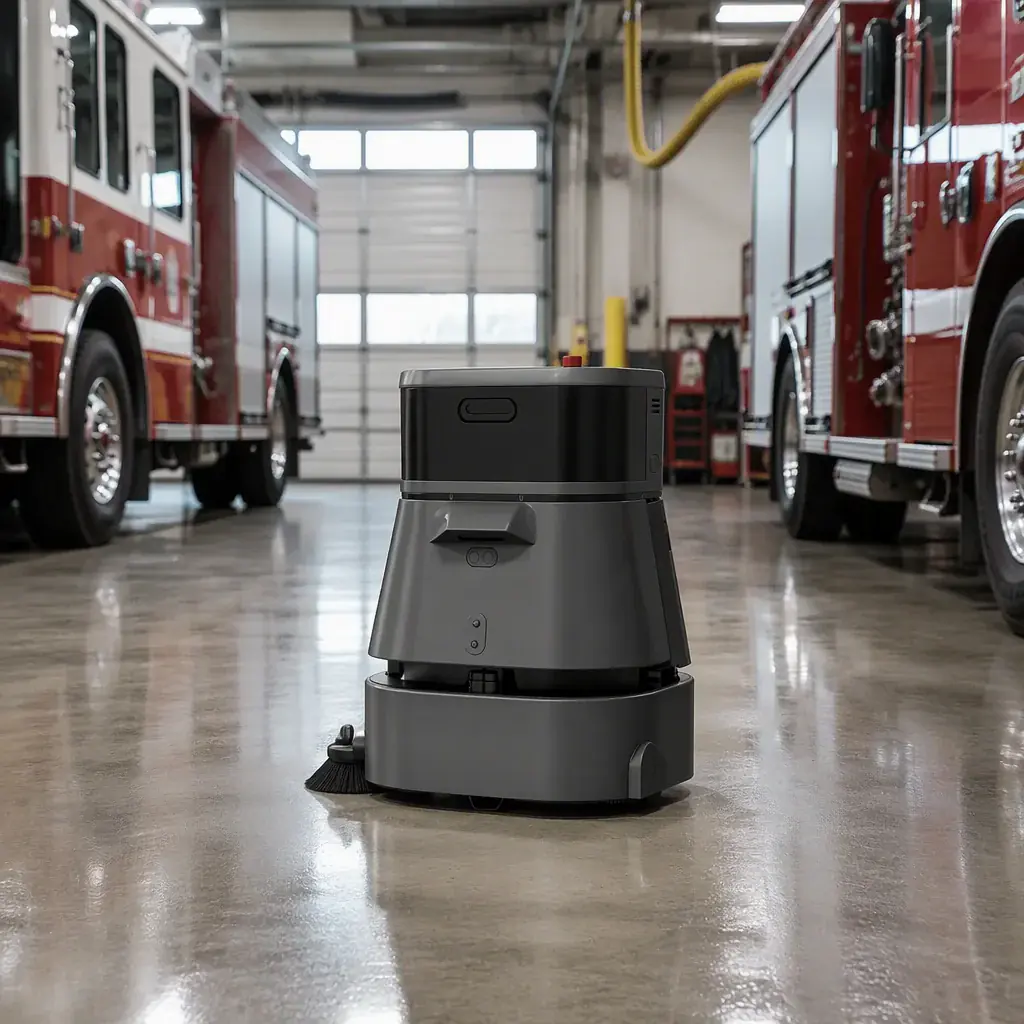
The apparatus bay is the hardest floor in the station to keep clean because it collects the residue of the emergency response mission itself: dust and gravel tracked in from aprons and roadways, oil drips from engine bays, salt and sand in winter regions, and the fine particulate that settles on bay floors from apparatus exhaust. A bay floor that looks dirty reads as a station that is not ready — and bay cleanliness is a visible part of every station inspection and every public tour.
CLEINBOT CC201 is the machine departments are deploying for this zone because it is built for exactly this contamination profile. The CC201 is an autonomous outdoor sweeper with an IP67-rated enclosure, a 800L auto-emptying station and LiDAR + IMU fusion navigation — the same machine outdoor autonomous cleaning deployment documents at campuses and industrial parks. In a station context, the CC201 runs a bay sweep on a night schedule: it navigates the bay's floor plan with its 180° obstacle detection, sweeps the full 60-foot bay in about 25 minutes, and auto-empties its dust bin into the station — the operator empties the 800L station weekly instead of the sweeper every 45 minutes.
The outdoor capability matters because the bay apron — the concrete pad where apparatus parks and crews do equipment checks — is the same surface problem with direct sun, rain and winter salt. A single CC201 covers both zones: the apron sweep in the afternoon (when bay doors are open and apparatus is out), and the interior bay sweep at night. The IP67 rating and UV-stabilized body panels handle the environment that destroys consumer-grade equipment in stations, and the operating range of -10°C to 50°C covers the seasonal envelope of most North American departments.
Living Quarters: Cleaning That Can't Wake the Crew
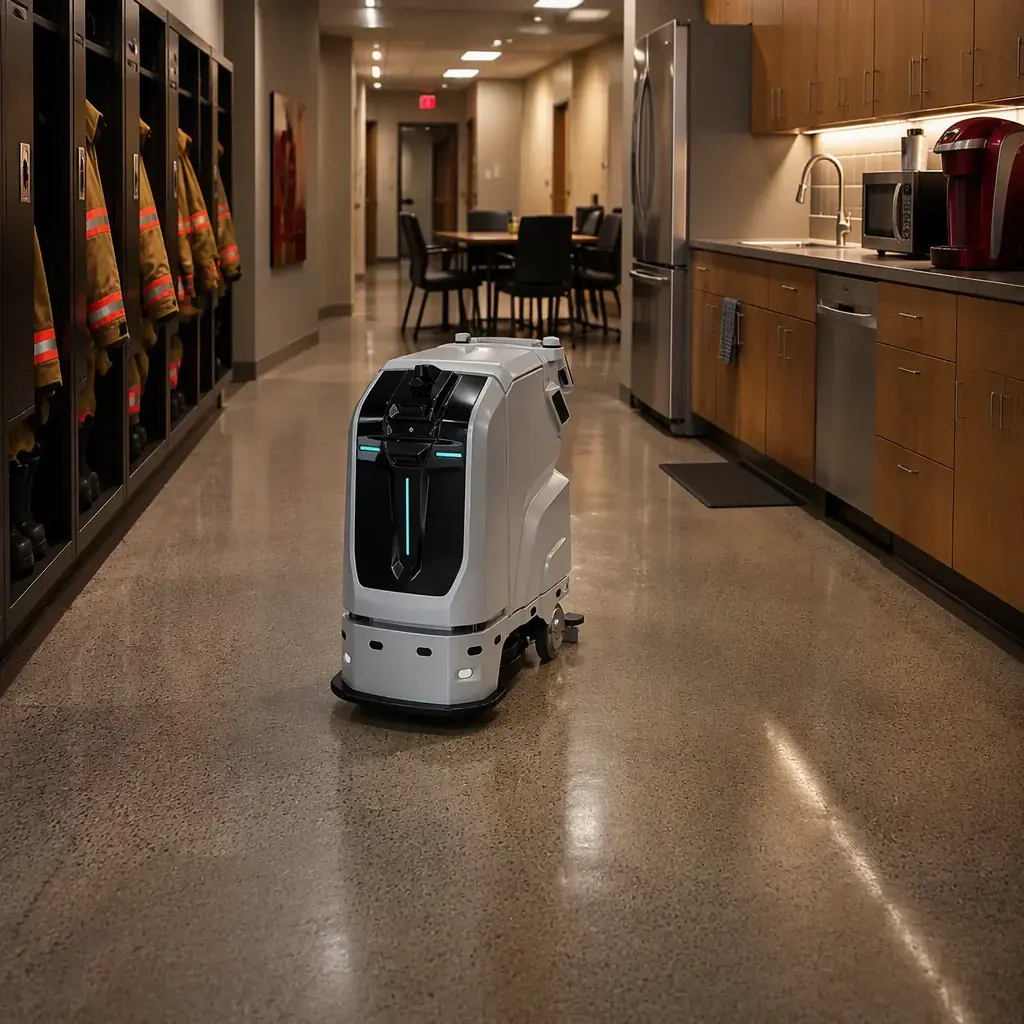
The living quarters are where the noise specification becomes a mission requirement. Firefighters sleep in shifts — a busy station's dormitory is occupied at all hours, and crews catching 30 minutes of rest between calls are the station's most valuable operational asset. A commercial scrubber running at 70+ dB(A) cannot operate in that environment; CLEINBOT M79's quiet mode at approximately 58 dB(A) — comparable to a normal conversation — is the difference between a machine that runs through the dormitory corridor during the day shift and one that is confined to a single weekly deep-clean.
The M79's scrub, vacuum and mop single-pass operation at up to 2,000 m²/h cleans the dayroom, kitchen, fitness room and corridor of a typical station's living quarters in under 30 minutes. The adjustable water output (0-300 mL/min) lets the operator dial near-dry for the wood-look flooring in the dayroom and full scrub for the kitchen and bathroom tile — and the 45L water tank with auto-return docking means the robot self-services between scheduled tasks. The safety standards and compliance framework applies here exactly as it does on factory floors: ISO 3691-4 governs the robot's operation around people, and the 180° obstacle detection automatically slows the machine near crew members — critical in a station where firefighters move through corridors with gear bags, SCBA packs and equipment in both hands.
The maintenance and TCO guide documents the cost structure that makes this defensible in a public budget: an IP67-rated robot with brush deck inspection at 500 operating hours and full service at 2,000 hours runs roughly $0.08-0.12 per cleaned hour in maintenance — versus $0.30-0.50 for a consumer-grade unit that needs component replacement every season. Departments that deploy the CC201 outdoors and M79 indoors consolidate service into a single visit, the fleet-level approach documented in service robot fleet management.
Contamination Control Around Turnout Gear
Station cleanliness has a second dimension that most venues don't face: contamination control around turnout gear. Firefighter cancer studies — including the NIOSH-funded research published in the Journal of Occupational and Environmental Medicine — have documented that fireground contaminants (PAHs, heavy metals, PFAS from gear) are tracked back into stations on boots, gear and apparatus, and the 2020s-era station-design standards now include designated contamination-reduction zones where gear is cleaned before crews enter living areas. The floors in these zones — the bay, the decon room, the gear storage corridor — need regular scrubbing with documented schedules, which is exactly what a logged, timestamped autonomous cleaning route provides: the fleet software logs each pass, and the log is exportable for the department's safety program.
This is the same documented-cleaning argument that the pharmaceutical GMP guide makes for cleanroom environments — when cleanliness is a documented safety requirement rather than an aesthetic preference, an autonomous robot with a logged route is not a convenience, it is the compliance mechanism. The industrial laundry and linen services guide covers the adjacent station function: the washing and decontamination of station uniforms and linens, where delivery robots move clean and dirty loads through the laundry corridor on scheduled runs.
Community Education & Station Tours
The public face of the station is a growing workload. Fire departments conduct an estimated 1.5 million station visits and educational programs annually across the United States — school field trips, fire-safety week events, scout badge programs — and every visit requires a tour guide, a safety briefing and a reset of the training room. CRUZR, the humanoid service robot, absorbs the repetitive layer: it greets arriving groups in the station's community room, runs the fire-safety orientation loop (stop-drop-roll, smoke alarm maintenance, exit planning), answers the three most common questions (bathroom location, tour start time, where the trucks are) and delivers the station-history spiel on loop while the firefighter host handles the deep-dive Q&A and the hands-on gear demonstration.
The reception and concierge deployment model documents the same split at corporate lobbies and government facilities: the robot absorbs the repetitive information layer, the human handles the exceptions. For stations that host evening community meetings — neighborhood associations, CERT training, fire-safety classes — the robot's configurable voice persona and multi-language capability (8 languages) matter in diverse districts where the station serves communities that do not all speak English at home.
Municipal Procurement: Making the Case to Budget Committees
The procurement question for a fire department is different from a private venue's: the money is public, the justification is a budget document, and the decision is made by a city council or fire commission, not a business owner. The government public sector guide covers the RFP framework that applies: departments specify the robot's noise level, cleaning throughput, IP rating and fleet software — not a brand — and score vendors against measurable criteria. The RFP and procurement template is directly reusable for the station automation bid.
Financing follows the same phased logic that RaaS and subscription models document for private venues: a $1,200-1,800 per month all-in subscription per robot maps cleanly to the crew-hours it returns to the mission — 2.4 hours per shift at $30-40/hour loaded municipal labor is $2,600-3,700 per month of returned capacity across three shifts. The budget planning framework walks through the full comparison, and the vendor evaluation framework gives the purchasing committee the scoring grid. The change management playbook covers the crew dynamic: firefighters initially view a cleaning robot as an insult to the station's tradition of self-maintenance, then discover the staff training and certification guide turns the station's engineer into the robot operator — and the crew gets its hours back for the work that actually saves lives.
The fire station is a 24/7 facility that never stops needing cleaning, staffed by people whose job is not cleaning. The departments modernizing their facilities in 2026 treat station upkeep as an automation problem — sweepers that keep the bay inspection-ready, scrubbers that clean the dormitory corridor without waking a sleeping crew, and a concierge that greets the school groups while the firefighters train for the next call. That is what a mission-ready station looks like when the building finally serves the mission.