
Service Robots for Distribution Centers & Parcel Hubs, From the Cut-Off Clock to Floor Coverage
At a glance: At a parcel hub the commercial risk is a missed cut-off, and cleaning competes with dispatch for the same minutes. This guide splits the hub into movement tasks and coverage tasks, works a 28,000 m² hub model, and covers the dock and network infrastructure that decides whether the fleet works in practice.
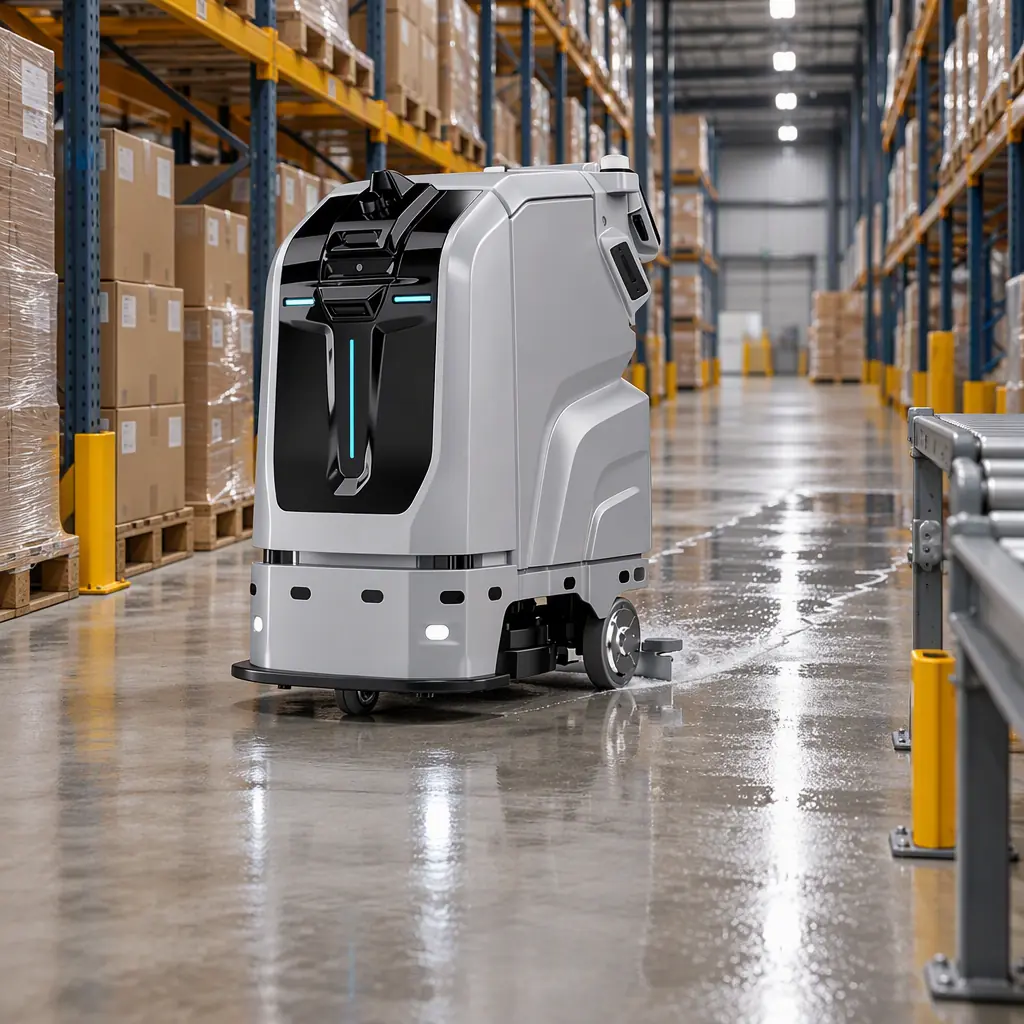
A logistics hub is a service-level agreement with a roof. The operator's commercial risk is a missed cut-off time, and every internal task that supports a cut-off competes for the same minutes. Cleaning, documentation runs and internal parcel movement are three such tasks, and at most hubs all three are still handled by people walking between them.
The reason autonomous fleets are landing at these sites first is not labour cost. It is that a hub's task list is unusually repetitive, unusually measurable and unusually easy to split between a machine that handles bulk movement and a machine that handles floor coverage. This guide works through what belongs on each, and the numbers at a mid-size hub.
Split the Hub Into Movement Tasks and Coverage Tasks
The first modelling decision is which machine class owns which task family. Getting this wrong is expensive, because a delivery robot cannot scrub and a scrubber cannot lift a tote.
| Task Family | Representative Jobs at a Hub | Machine | Why This Class |
|---|---|---|---|
| Internal payload movement | Document pouches between ops office, customs desk and dispatch; sample and part runs to the returns bench; consumable restock to packing stations | AOMAN D1 | 40 kg payload across four 10 kg tray tiers with 270° open access from three directions; 650 mm minimum aisle clearance fits narrow packing aisles; 257° front/rear LiDAR ring and RGB-D sensors at 202° front handle pallet and cage traffic; auto-docking on infrared guide with roughly 4 h full charge from a 20 Ah LiFePO4 pack |
| Floor coverage | Packing hall aisles, sortation hall, dispatch dock aprons, welfare and office block | AOMAN C1 | Up to 2,040 m²/h with a 790 mm squeegee; 5 cm toe-height obstacle sensing clears dock leveller lips and floor joints; 120 L total tank capacity covers a large hall between refills |
| Office, welfare and meeting rooms | Ops offices, control room, canteen, training room | AOMAN C2 Pro | 440 mm cleaning width and 700 mm narrow-aisle clearance; up to 11 h dust-mopping endurance and roughly 4,400 m² per run covers an administration block on one charge; ≤32 dB operation allows daytime cleaning beside occupied desks |
| External yard, apron and gate approach | HGV apron, trailer park, gatehouse approach, staff car park | AOMAN C1 (daylight, low-traffic window) | Same unit as the packing hall, working the outdoor surfaces between trailer movements |
Three of the four families collapse into two machine classes, and the payload family is served by units that were designed for hotel tray service rather than for logistics. That is not as strange as it reads: a document pouch run and a room-service run have identical requirements, a sealed compartment, a scheduled route, and the ability to hand off to a human without anyone waiting at a fixed point. The hospital equivalent of the same pattern is set out in the hospital internal logistics guide.
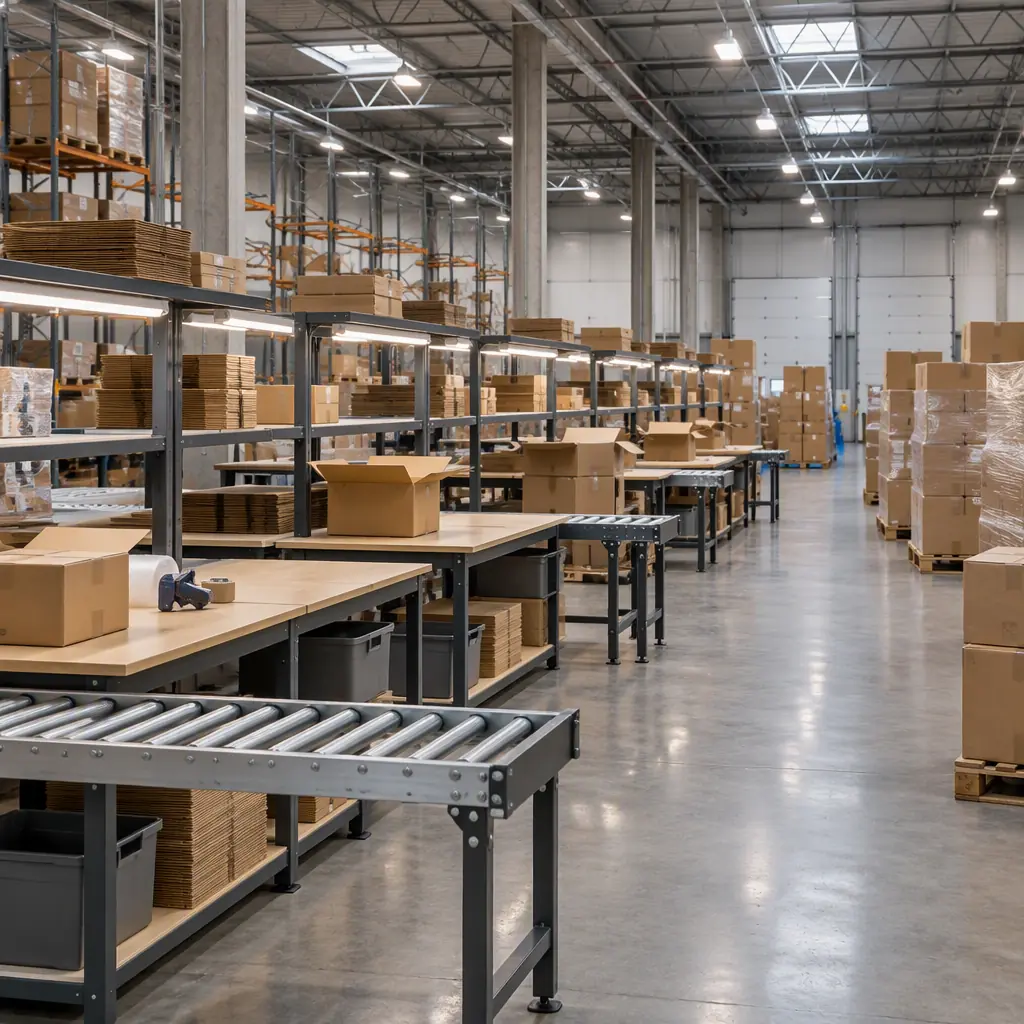
The Cut-Off Clock Reframes Every Saving
At most commercial sites the benefit of automation is labour hours. At a hub the primary benefit is minutes recovered inside a cut-off window, and the two do not convert into each other automatically.
A D1 running a fixed document-and-sample circuit removes between 4 and 7 km of walking per shift from an operations team. At a mid-size hub that is not primarily a labour saving; it is the difference between a customs document reaching dispatch at 15:40 and at 16:05, where the trailer leaves at 16:00. Missed cut-offs at a hub are typically costed as re-routed freight, expedited courier charges or penalty clauses. And any one of those events in a quarter can outweigh a year of labour savings.
Model the cut-off, not the headcount. Count the internal tasks that sit on the critical path to a daily cut-off before modelling labour at all. At a mid-size parcel hub that list typically runs to four or five task types: document movement, returns-bench parts, consumable restock, security patrol and dispatch-dock spill response. Automation value concentrates in the first three.
The Numbers at a Mid-Size Hub
The model takes a 28,000 m² hub with two daily departures, a day shift of 42 operational staff and a night sortation team of 30, with cleaning currently split between an internal team and an external contract.
| Cost Line | Manual Baseline (annual) | D1 + C1 + C2 Pro (annual) | Change |
|---|---|---|---|
| Internal document and sample runs | $93,600 2.5 FTE equivalent at $18/h fully loaded | $18,720 0.5 FTE for exception handling and tray hygiene | −$74,880 |
| Floor cleaning labour | $269,570 7.5 FTE plus contract | $122,850 3.5 FTE on detail, welfare and restrooms | −$146,720 |
| Contract cleaning | $54,000 External monthly deep clean | $12,000 Quarterly only | −$42,000 |
| Consumables and machine service | $18,400 Manual equipment | $61,300 3 units, dense duty cycle, tray and pad replacement | +$42,900 |
| Charging and software | $0 | $19,100 3 licences plus power | +$19,100 |
| Missed-cut-off exposure | Costed per event, typically $8,000-25,000 | Materially reduced, not eliminated | Not modelled |
| Annual total (modelled lines) | $435,570 | $233,970 | −$201,600 |
Two numbers in that table deserve attention. First, consumables more than triple, because three machine classes means three consumable streams and a hub's dust and debris load is harder on brushes than an office is. Second, the missed-cut-off line is deliberately not modelled as a saving. Those events fall unevenly through a year, and claiming them as an annual benefit is how a deployment gets written up as a failure in its second year. Treat cut-off improvement as an operational benefit and a reason to deploy, not as a number in the payback calculation.
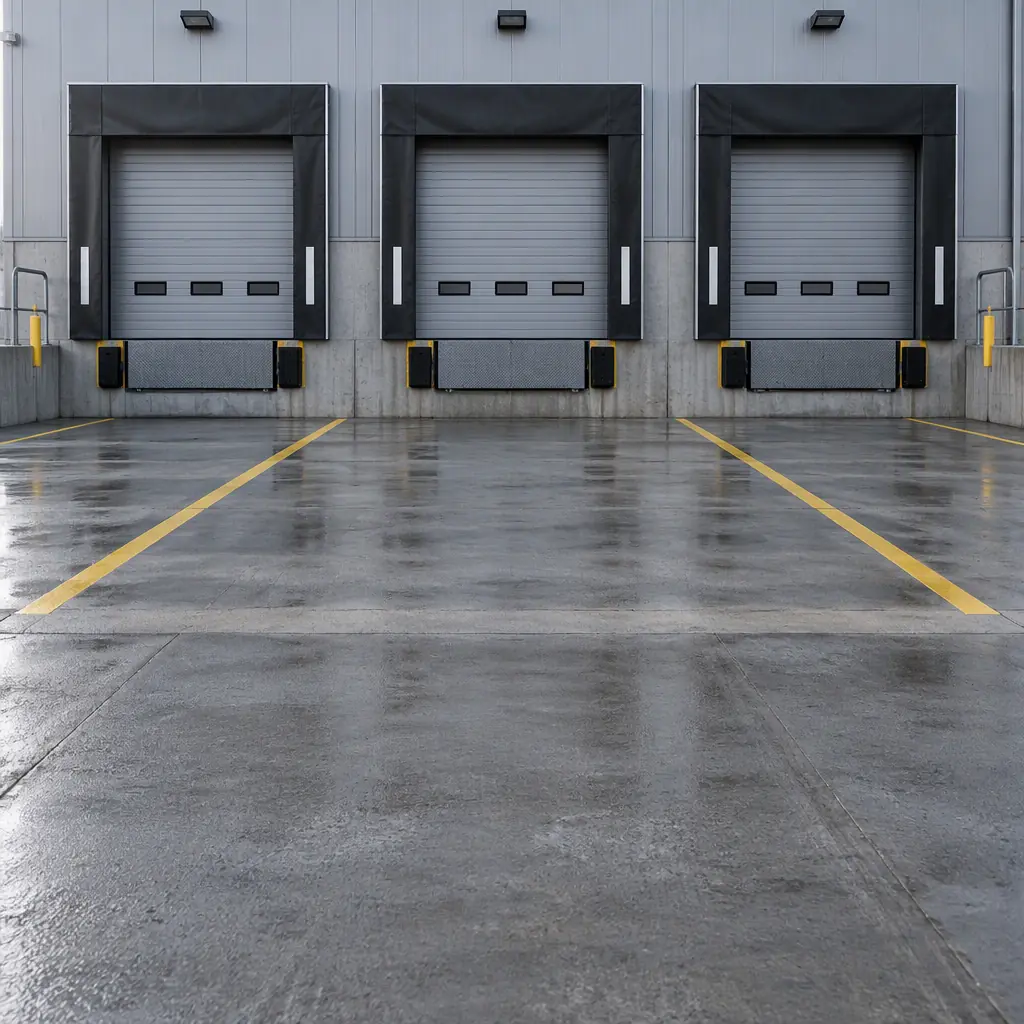
Infrastructure: the Dock, the Network and the Lift
Three infrastructure items decide whether the fleet works in practice, and all three are cheaper to solve before the machines arrive.
The charging dock. A D1 charges to full in approximately 4 hours; three units charging on a staggered night cycle impose a modest but non-zero load that needs a dedicated circuit near the fleet's working area. Siting docks in the sortation hall is a fire and blockage question, so a wall alcove or fenced bay is the practical answer.
The network. The D1 runs Wi-Fi 2.4/5 GHz with LoRa and optional 4G, and the C1 and C2 Pro rely on the same fleet layer for task dispatch and coverage reporting. Warehouse racking is hostile to Wi-Fi at floor level and gateways frequently sit above a steel mezzanine. A site survey before deployment prevents the classic failure where units pause at the back of the packing hall every third circuit.
The interface with existing systems. Where a hub already runs a WMS or a task-management system, the realistic integration is task-level: the fleet layer receives a job, executes it and returns a completion event. Hub managers should not expect the robot platform to replace the WMS. The integration choices and their cost implications are worked through in the BMS and sensor integration guide.
Sequencing the Fleet
At a hub the right first move is almost always the D1, not the scrubbers. Document and sample runs have no surface-quality risk, they are easy to observe, and they build the organisational confidence that a floor-cleaning fleet needs before it is given a night window. Coverage machines follow on the packing hall and welfare block.
Fleet management, coverage reporting and the licensing cost structure are covered in the custodial robot software buyer's guide. Sizing arithmetic for power and dock provision is in the charging infrastructure planning guide, and the multi-site version of the same rollout is set out in the multi-site deployment strategy.
What to Measure From Week One
Four metrics: on-time task completion rate against the dispatch schedule, walking distance removed per shift (from the task log, not from an estimate), interventions per 100 machine hours, and floor coverage percentage per hall per week. The last one catches the most common quiet failure at a hub. A machine that reports clean runs but is being excluded from a hall by a badly drawn virtual wall, so the actual coverage quietly falls while the dashboard looks healthy.
Tell us your hub's cut-off schedule, hall areas and current internal-run workload, and we will model the machine split and the dock requirements against your actual operating day. Contact us.