A licensed childcare center in Charlotte, North Carolina, cares for 110 children across six classrooms — infants, toddlers and preschoolers — with a staff of 14 teachers and three administrators. The center's state license requires daily floor cleaning and disinfection of all classroom and common-area floors, documented in a cleaning log that the licensing inspector reviews. The director's operational reality: every staff member is assigned to a classroom to meet state-mandated staff-to-child ratios (1:4 for infants, 1:6 for toddlers, 1:10 for preschoolers), which means there is nobody free to clean during operating hours, and the cleaning falls on the director and assistant director after the last child leaves at 6 PM — followed by the meal prep for the next day's CACFP-subsidized breakfast and lunch service.
The center's leadership team measured the load: floor cleaning and disinfection consumed 1.8 staff-hours per day, meal and snack delivery between classrooms consumed another 45 minutes per day (teachers leaving classrooms to fetch carts, which breaks ratio compliance), and the check-in/check-out window — 30 minutes of concentrated parent traffic each morning and evening — consumed 2.5 combined hours of front-desk time. Across a month, that is over 120 staff-hours that a center with a 3-5% operating margin cannot staff for. This is why early-childhood facilities are adopting service robots faster than almost any other vertical in 2026: the venue is small, the hygiene standard is a license requirement, and the labor simply does not exist.
The Hygiene Floor Problem in Early Childhood Settings
Childcare floors are a documented infection vector. The CDC's guidance for early childhood programs identifies floors and high-touch surfaces as primary transmission surfaces for the viruses that drive childcare absenteeism — norovirus, rotavirus, rhinovirus and hand-foot-and-mouth disease — and a National Institute of Health review of childcare infection studies found that children in group care experience 50-70% more respiratory and gastrointestinal infections than home-raised children. State licensing rules respond to this with explicit floor-cleaning requirements: most states require daily cleaning and disinfection of floors in classrooms, bathrooms and food-preparation areas, with logs that inspectors can audit.
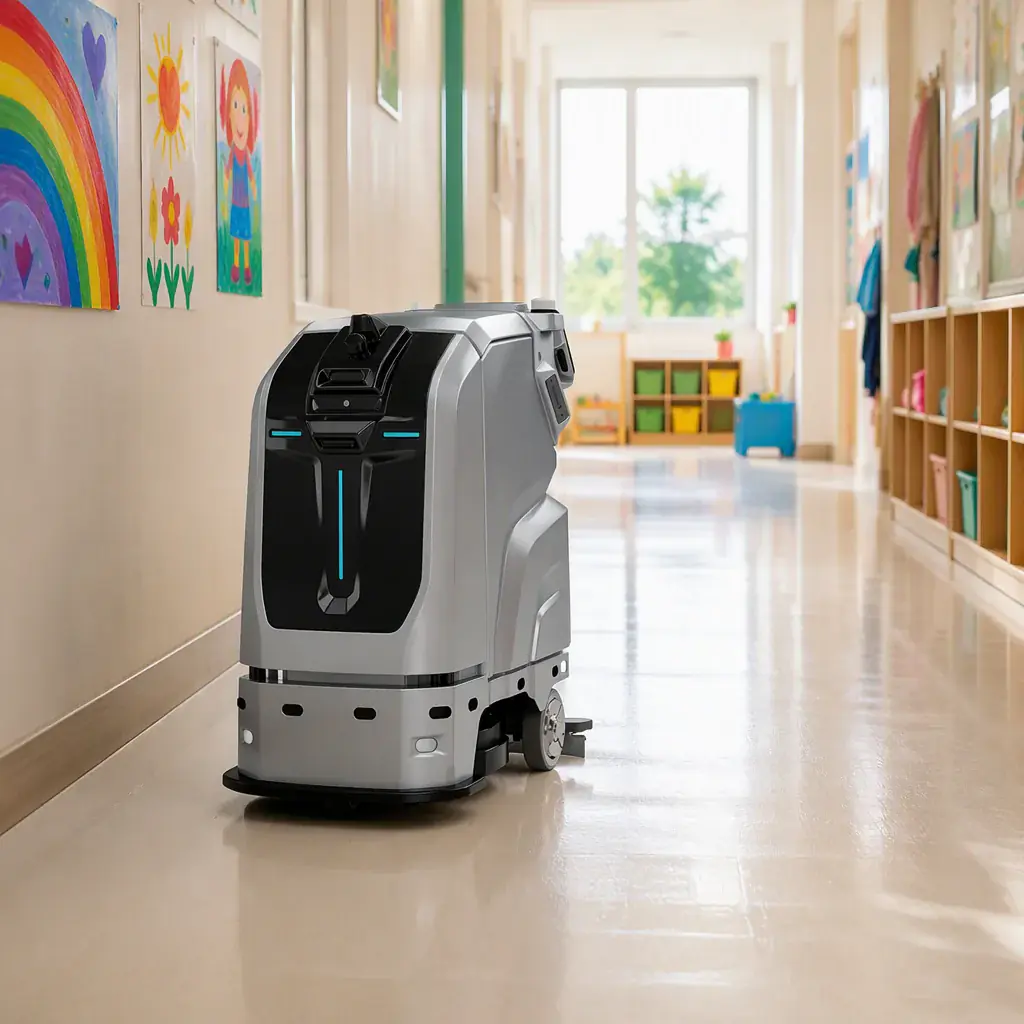
The commercial cleaning robot buyer's guide documents the automation pattern that applies: the machines that work in childcare are the same scrubbers that work in hospitals and clinics, because the requirement is disinfection-grade cleaning on a documented schedule. CLEINBOT M79's scrub, vacuum and mop single-pass operation at up to 2,000 m²/h cleans a typical center's 8,000-12,000 square feet in about an hour, and the adjustable water output (0-300 mL/min) lets the operator dial near-dry for wood floors and full scrub with cleaning solution for the tile and vinyl in classrooms, bathrooms and the kitchen.
Quiet Cleaning Around Naptime
The specification that separates a childcare scrubber from an office one is noise. Children nap for 1-2 hours in the middle of the day, and a cleaning machine running at 70+ dB(A) is impossible in that window. M79's quiet mode at approximately 58 dB(A) — comparable to a normal conversation — lets the center run the classroom-corridor pass during naptime without waking children, and the full-floor disinfection pass after closing. The 45L water tank with auto-return docking means the robot self-services between scheduled tasks, and the 180° obstacle detection from LiDAR and ultrasonic sensors automatically slows the machine near people — a specification that matters in a building where small children are at floor level, the exact safety framework documented in the safety standards and compliance guide.
The hospital delivery robots guide documents the adjacent reality: the same machine class that runs disinfection routes in pediatric hospital wings is what childcare centers deploy, because the hygiene standard is the same. The healthcare robots guide covers the infection-control rationale in detail, and the fleet management systems that schedule robots across multi-site deployments let a center group (a 5-location franchise, for example) run all sites on one dashboard with per-center schedules matched to each site's licensing inspection rhythm.

Meal Delivery: Protecting the Staff-to-Child Ratio
Meal service is where delivery robots deliver their most direct ROI in childcare, because the math is about ratios, not just labor. The Child and Adult Care Food Program (CACFP) funds breakfast, lunch and snack service in licensed centers — over 4.2 million children receive CACFP meals daily — and every time a teacher leaves a classroom to fetch the meal cart, the center is technically out of ratio until the teacher returns or another staff member covers. Centers that run a 45-minute lunch service with two teachers leaving per classroom are losing ratio compliance for 90 classroom-minutes per day — a licensing exposure that directors take seriously.
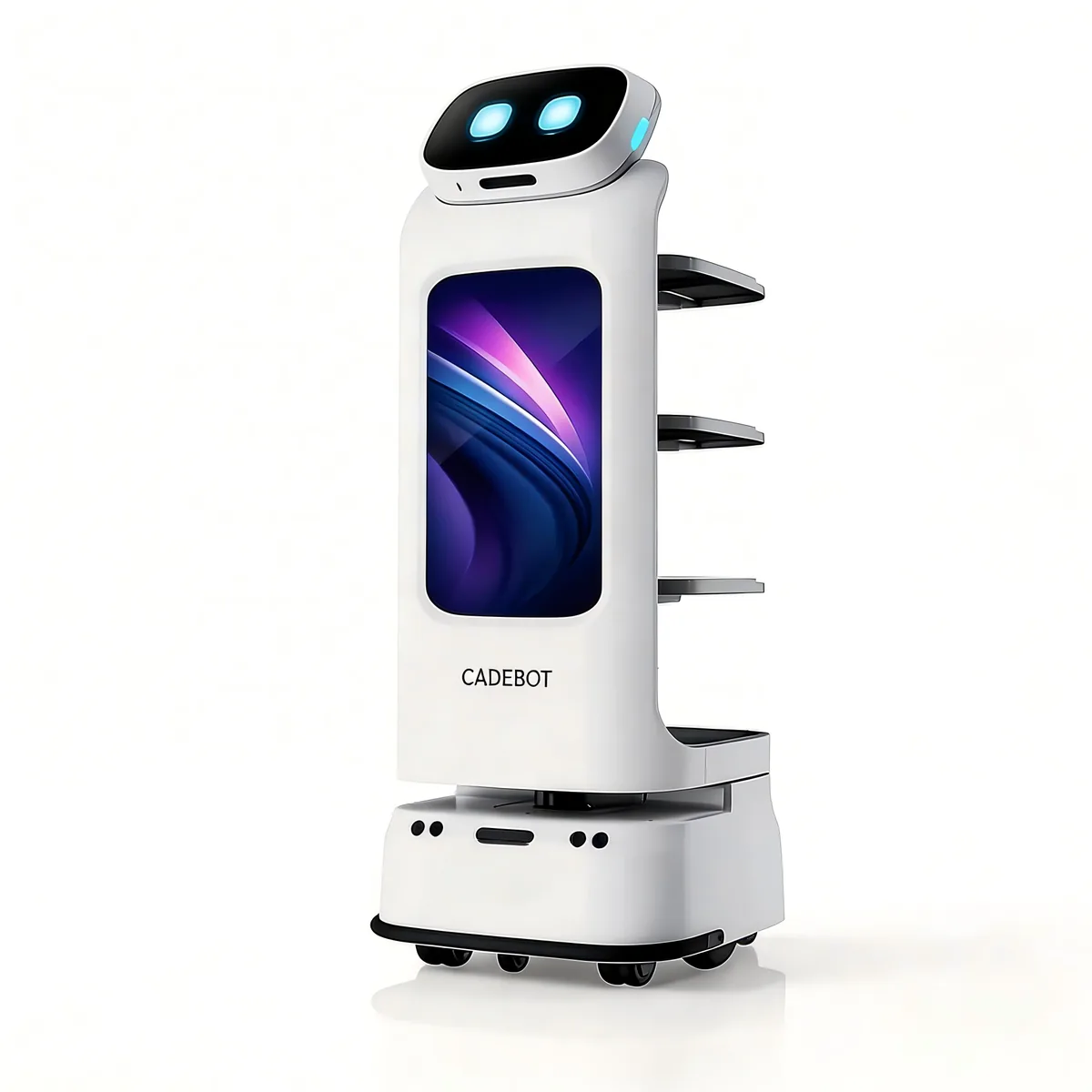
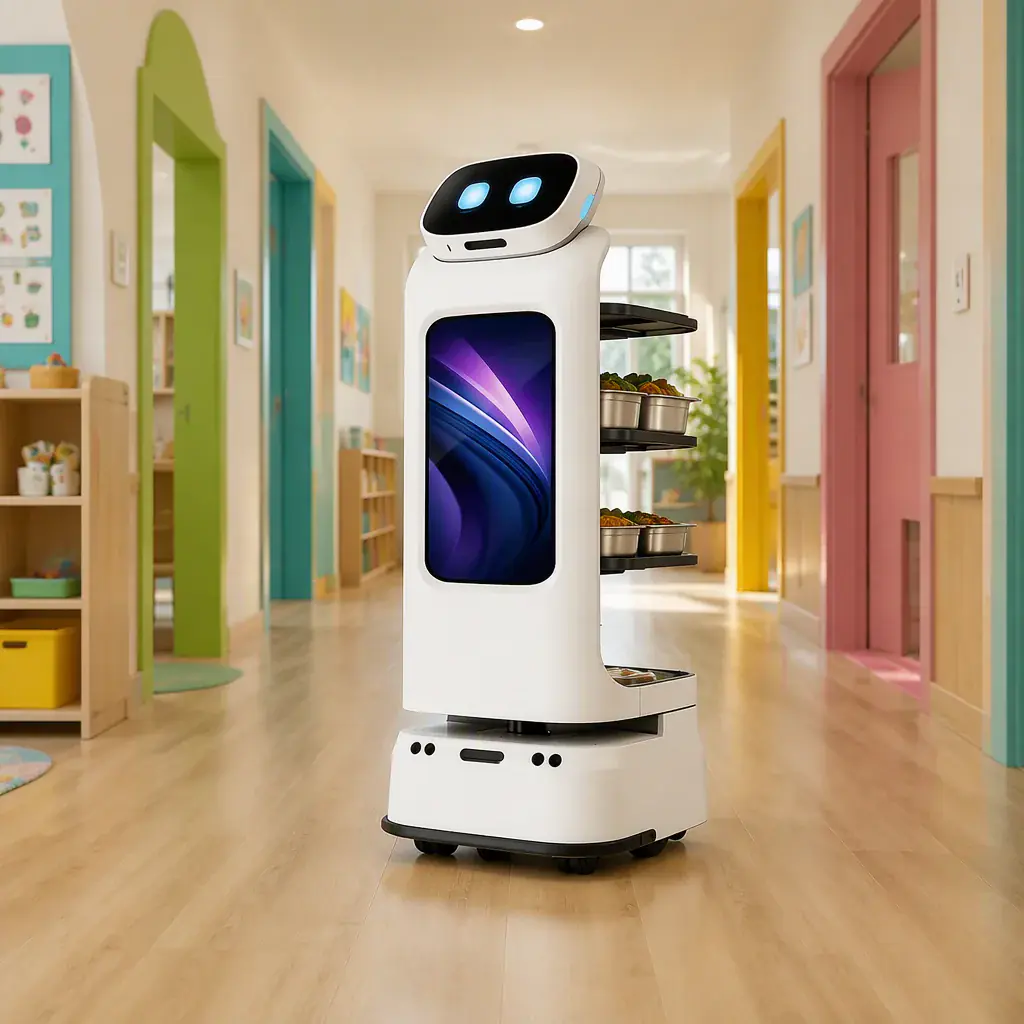
CADEBOT L100's 4-layer tray system and 60 kg payload is the machine built for this: it moves the meal carts and snack bins from the kitchen to each classroom on a scheduled route, the same delivery pattern documented in the delivery robot selection guide. The robot's SLAM 3.0 navigation handles the center's corridor network, the 8-12 hour battery covers the full day including the afternoon snack run, and the 8-language voice capability is a practical feature in centers with multilingual staff. The teachers stay in ratio, the food arrives at the scheduled CACFP service time, and the kitchen staff load the trays once instead of walking them to six classrooms.
Secure Reception: Check-In as a Compliance Function
The front desk in a childcare center is a security checkpoint, not a courtesy counter. State licensing rules require documented check-in and check-out, authorized-pickup verification, and visitor logging — and the morning window, when 60-110 children arrive with their parents over 30 minutes, is the highest-risk period of the day. A pickup verification failure is the incident every director fears, and the front-desk staff's attention is split between greeting children, checking IDs and logging arrivals.
CRUZR, the humanoid service robot, assists this process under human supervision: it greets arriving families, runs the check-in queue (announcing each child's arrival to the front-desk system), verifies authorized pickups against the roster and answers the repetitive questions (where is classroom 3, what time is pickup, where is the lost-and-found) while the human front-desk staff handles the exceptions — new-family registration, custody-issue conversations and late-pickup notifications. The reception and concierge deployment model documents the same division of labor at corporate lobbies: the robot absorbs the routine 80%, the human handles the sensitive 20%. The smart office buildings guide shows the visitor-management pattern that childcare centers are adopting: logged visits, timestamped check-ins and an audit trail — which is exactly what a licensing inspector wants to see.
Licensing, Insurance & the Deployment Decision
Before deploying robots in a childcare setting, directors should verify three things with their licensing agency and insurer: that the machine's operation does not conflict with any ratio-counting rule (robots are not staff and never count toward ratios), that the robot's sensors and safety systems meet the facility's child-safety requirements (the safety standards and compliance guide covers ISO 3691-4 for autonomous mobile robots operating around people), and that the documented cleaning logs the robot produces satisfy the licensing inspector — which they do, more reliably than a handwritten log.
The financing question resolves the same way it does for other thin-margin venues: RaaS and subscription models put the hardware at $1,200-1,800 per month all-in, which maps to the 120+ staff-hours the center reclaims per month. The budget planning framework walks through the comparison for a center director, the vendor evaluation framework provides the scoring grid, and the change management playbook covers the staff dynamic — teachers initially worry the robot will run during classroom time, then discover it is scheduled around naps and meals. The staff training and certification guide shows how one administrator becomes the center's robot operator, the same career path documented in schools and education facilities.
Childcare centers are the most ratio-constrained, hygiene-regulated and staff-starved facilities in commercial real estate — and they are the facilities where robots deliver the clearest benefit: a floor that is disinfected and logged every night, meals that arrive without breaking ratio, and a front desk that never takes its eyes off the pickup line. The centers leading on quality ratings in 2026 are the ones that treated facility automation as a way to give teachers back their time with children — not as a replacement for anyone, but as the extra pair of hands the ratios never allowed.